
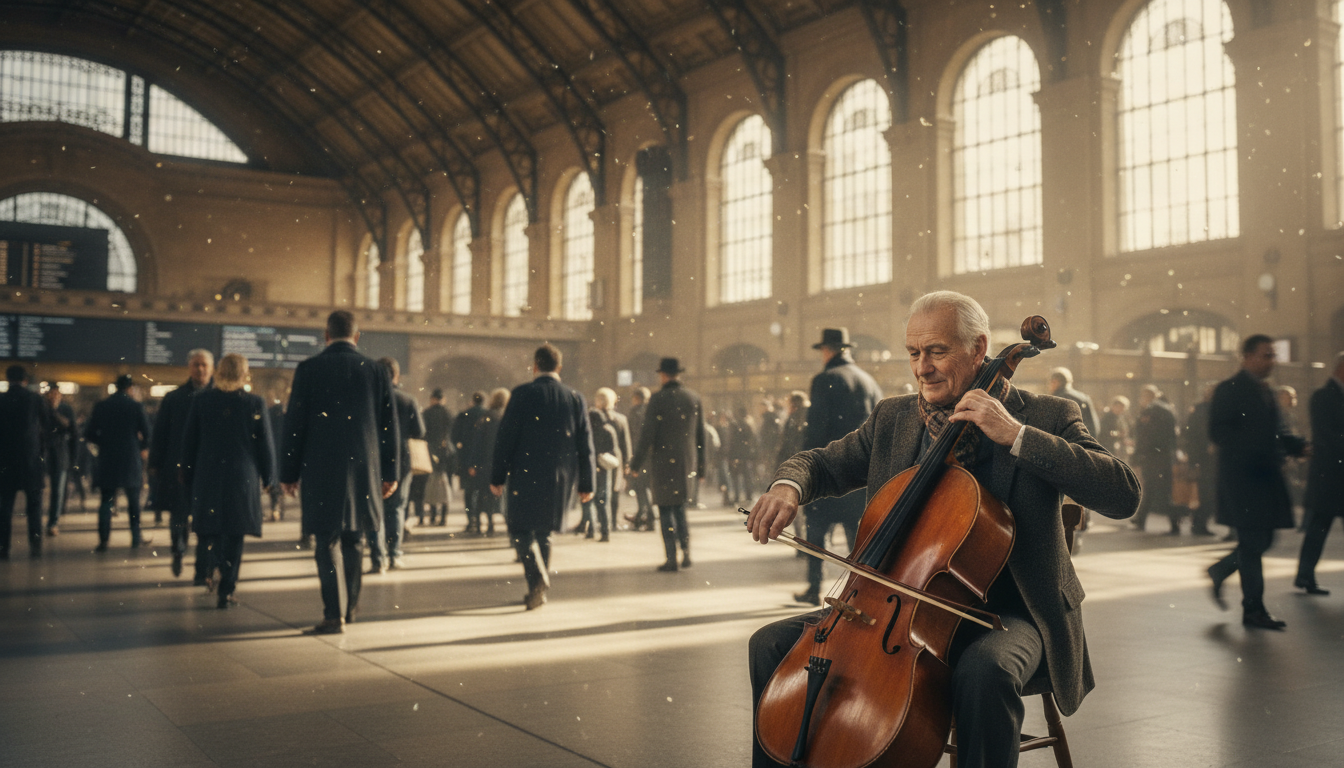
In the vast, echoing atrium of the city’s central station, where time is measured not in hours but in footsteps and departures, there sat a man named Elias. He was as much a part of the architecture as the marble pillars and the brass clock that hung suspended above the concourse like a judgmental moon. Elias sat on a collapsible stool near track seven, cradling a cello that wore its age in scuffs and scars, a deep mahogany bruise against the grey stone of the terminal.
Elias was a virtuoso of the invisible. Thousands of people surged past him every morning, a river of grey coats, clutching coffee cups like lifelines, thumbs scrolling across screens, eyes fixed on the middle distance. They were rushing toward futures that hadn’t happened yet, running from pasts they couldn’t outpace. And it was for them—specifically and exclusively for them—that Elias played.
There was a peculiar rule to his art, a self-imposed covenant that bound him to the shadows of the station. Elias only played when no one was listening. The moment a commuter slowed their pace to admire the melody, the moment a child tugged on a mother’s sleeve to point at the old man with the bow, Elias would stop. He would lift the bow abruptly, rest his hand on the neck of the instrument, and stare pleasantly at the ceiling until the attention drifted away. He was a musician of the periphery, providing a soundtrack for the distracted, a score for the unaware.
He believed that music, true music, was not meant to be analyzed or applauded. It was meant to be inhaled like air. It was meant to bypass the critical mind and settle directly into the marrow of the bone. When people listened, they judged. They wondered if he was sharp or flat, they recalled other songs, they felt pity or admiration. But when they ignored him, the music slipped past their defenses. It became part of their internal weather.
On a rainy Tuesday, when the station smelled of damp wool and ozone, a woman named Clara hurried toward the escalators. Clara was thirty-four, and her heart felt like a clenched fist. She had just left a lawyer’s office where the final papers of a divorce were sprawled across a mahogany desk, awaiting signatures. The noise of the station was an assault, a physical weight pressing against her temples. She checked her phone for the tenth time, though no one had messaged her. She was entirely consumed by the loud, static noise of her own unraveling life.
She did not see Elias. She did not see the way he adjusted his grip on the bow as she approached. She was the perfect audience.
Elias began to play. It was a low, mournful resonance at first, a sound that mimicked the vibration of a heavy train leaving the platform. It matched the frequency of Clara’s anxiety perfectly. As she walked, the music swelled, transitioning from a drone into a rich, complex melody that climbed the air like a vine. It was a song about releasing heavy things, a composition of unburdening.
Clara kept walking, her heels clicking a staccato rhythm on the floor. She didn’t stop. She didn’t look. But something in the atmosphere shifted around her. The frantic chatter in her mind, the rehearsal of arguments and the tallying of regrets, suddenly found a container. The music held the chaos for her. Without realizing it, her shoulders dropped two inches. The clenched fist in her chest loosened just enough to let a breath pass through.
The music wove itself into the ambient noise of the announcements and the shuffling feet. It colored the grey light filtering through the high windows, turning it a soft, forgiving amber. Clara reached the escalator and stood still, letting the steps carry her upward. She felt a sudden, inexplicable urge to forgive herself. It wasn’t a thought she had generated; it was a feeling that had arrived, delivered on a wavelength she hadn’t known she was receiving.
Down below, Elias watched her ascend. His hand moved with fluid grace, his eyes closed, pouring every ounce of his soul into the back of a stranger who would never know his name. As soon as she disappeared from view, he lifted the bow and silence reclaimed his corner.
It was intricate work, playing for the oblivion of others. Elias often felt like a gardener watering plants in the middle of a thunderstorm. He saw the businessman who had forgotten what he was working for; for him, Elias played a bright, staccato allegro that tasted of childhood summers and bicycle tires on pavement. He saw the teenager overwhelmed by the pressure to become something specific; for them, Elias played a wandering, jazz-inflected improvisation that celebrated the beauty of getting lost.
He remembered the faces, even if they never saw his. He remembered the way their gaits changed as they passed through his sonic field. He saw the subtle softening of jaws, the slowing of frantic strides, the sudden, confused wiping of a tear from a cheek that the owner couldn’t explain.
One afternoon, a young man named Julian actually stopped. Julian was a musician himself, a student at the conservatory uptown, carrying a violin case on his back. He had ear training; he heard the nuance in Elias’s playing from fifty feet away. The technical proficiency was staggering. Julian stopped in his tracks, weaving through the crowd to get closer, his eyes wide with discovery.
“Excuse me,” Julian began, stepping up to the crate. “That phrasing… it was…”
Elias froze. The bow hovered inches from the strings. He looked at Julian with a kindly, but firm, expression. He said nothing. He simply waited.
“Please, don’t stop,” Julian pressed, eager to learn. “I was listening.”
“That is the trouble,” Elias said softly, his voice like dry leaves. “Music is medicine, son. You cannot heal the wound if you are picking at the bandage.”
Julian blinked, confused. “But you’re brilliant. You should be in a hall. People should hear this.”
“They do hear it,” Elias smiled, gesturing to the rushing throng of humanity. “They hear it with their blood. They hear it with their ghosts. You are listening with your ears. That is too small a vessel.”
Julian stood there for a long time, watching the old man sit in silence. Eventually, the awkwardness grew too great, and the young student turned to leave, disappointed. He walked away, shaking his head, checking his watch, worrying about being late for his theory exam.
The moment Julian’s mind shifted from the music to his schedule, the moment he became distracted by his own life again, Elias began to play. A soaring, triumphant melody followed Julian toward the exit, a song about the courage it takes to be misunderstood. Julian felt a sudden surge of confidence about his exam, a lightness in his step, unaware that he was finally hearing the music the way it was intended to be heard.
Years went by, and the station changed. The mechanical departure boards were replaced with digital screens. The coffee stalls became sleek franchises. But Elias remained, greyer now, his movements slower, but his sound richer. He became a myth among the station staff, the janitors and the ticket agents who knew his secret. They knew never to acknowledge him directly. They swept around his crate with averted eyes, offering him the respect of invisibility.
The magic of Elias was not that he changed the world, but that he softened it. He was the insulation between the human spirit and the grinding machinery of modern existence. He provided the padding that kept hearts from breaking upon impact with a hard day.
On his final day at the station, Elias packed his cello into its case just as the evening rush hour peaked. The sun was setting, casting long, dramatic shadows across the floor. He stood up, his joints popping, and looked out at the sea of strangers. A thousand lives intersecting, a thousand stories rushing toward dinner tables and empty apartments and lovers’ arms.
He didn’t play a final song. He realized, with a quiet satisfaction, that he didn’t need to. The station itself had its own rhythm now. The footsteps, the announcements, the laughter, the rolling wheels—it was all a symphony. He had spent decades tuning the room. Now, it could play itself.
As Elias walked toward the exit, carrying his life in his hand, a woman bumped into him. It was Clara, years older now, holding the hand of a small child. She didn’t recognize him. She didn’t know he was the reason she had forgiven herself on a rainy Tuesday long ago.
“Oh, excuse me,” she said, breathless and smiling.
“No harm done,” Elias replied.
Clara paused. She looked at the cello case, then up at his face. A strange, warm familiarity washed over her, a sense of safety she couldn’t place. “Have a beautiful evening,” she said, her voice lingering on the words.
“I believe I will,” Elias said.
He walked out into the city night, where the traffic hummed and the sirens wailed, ready to listen to the music of a world that didn’t know he was there.