
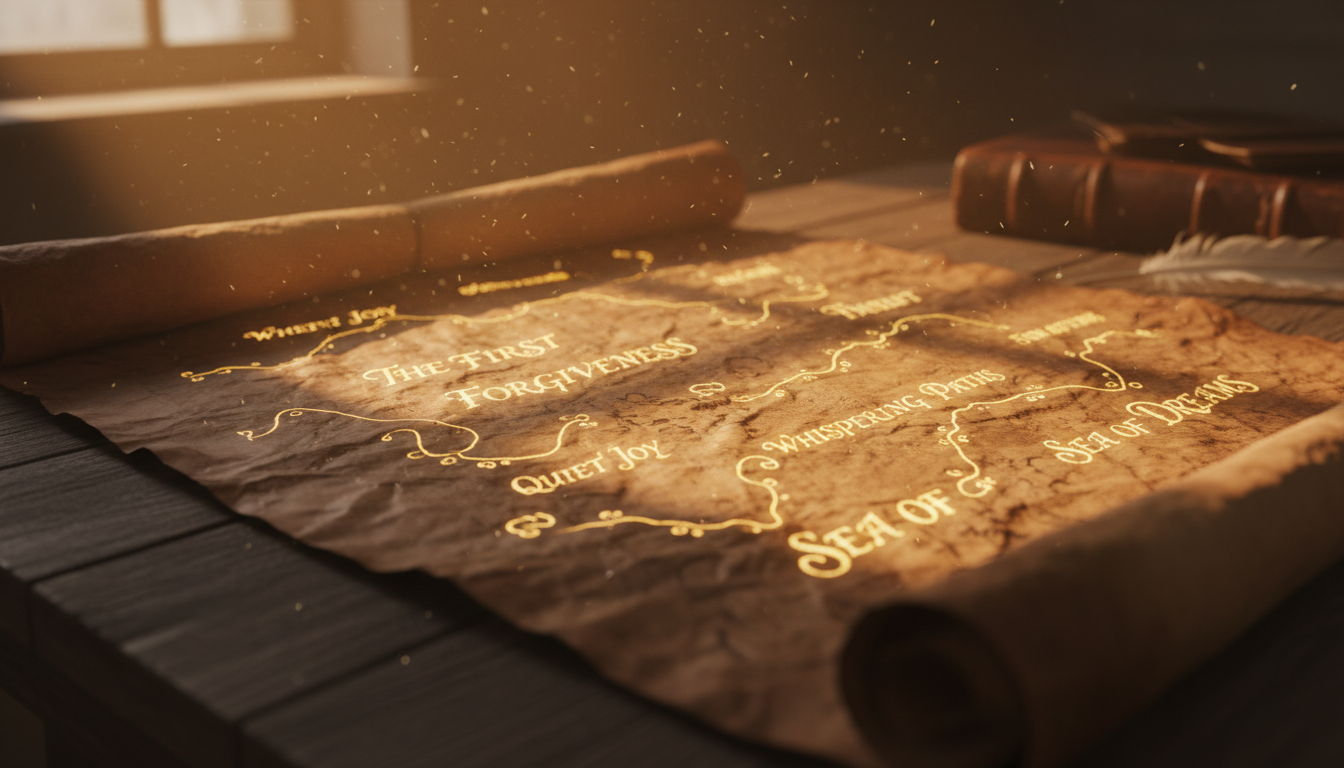
Elias was a man of coordinates. As a surveyor for the county, his life was governed by the rigid certainty of longitude and latitude. He found comfort in the fact that the world could be pinned down, measured, and flattened onto a sheet of paper. A mountain was an elevation gain; a river was a blue line with a calculated flow rate. Everything had a place, and every place had a name.
But for all his precision, Elias felt remarkably lost.
It wasn’t a spatial confusion—he knew exactly where his apartment was, where the grocery store sat in relation to the post office, and how many miles lay between his front door and the ocean. It was an internal drifting, a gray fog that had settled over his chest ever since his daughter, Maya, had moved across the country. The silence in his house was a vast, unmapped territory he didn’t know how to navigate.
The map appeared on a Tuesday, tucked inside a box of old atlas supplements he had bought at an estate sale. It didn’t look like the others. It was heavy, the paper thick and textured like pressed cotton, smelling faintly of cedar and rain. When Elias unrolled it on his drafting table, expecting to see the topographical lines of the mesmerizingly complex coastline or the grid of a city, he saw… nothing.
Or rather, not nothing. There were no borders. No names of cities. No oceans labeled in serif fonts. Instead, scattered across the creamy expanse of the paper were tiny, handwritten ink blots. They weren’t fixed; they seemed to shimmer slightly under the lamp light, moving with the slow, rhythmic breathing of a living thing.
He leaned in, adjusting his spectacles. The text was microscopic but legible. The first point, located roughly where the town square would be, didn’t say "Main Street." It read: The Tuesday You Finally Exhaled.
Elias frowned. He looked at another point, further ‘north’ on the paper. The Smell of Burnt Toast and Laughter, 1998.
His heart gave a strange, jagged thump. He remembered that morning. He had burned breakfast, and instead of being annoyed, his late wife had laughed until she cried, the sound bright and ringing in their small kitchen. It was a nothing moment, a throwaway minute in a decade of marriage, yet reading the words on the parchment brought the warmth of that sunbeam rushing back into his cold study.
This was not a map of space. It was a cartography of the heart.
Navigating the Invisible
For the next week, Elias became obsessed. He abandoned his digital surveying tools and spent his evenings hunched over the parchment. He realized quickly that the map didn’t show the whole world—only his world. And it didn’t show where he had been, but rather, where he had felt.
Most of the map was blank. The miles of highway he drove to work every day? Invisible. The hours spent in meetings? Nonexistent. The map only cared about resonance. It plotted the geography of impact.
One evening, feeling particularly heavy with the silence of the house, Elias noticed a new cluster of dots forming in the corner of the paper. They were faint, like a bruising on the page. He brought his magnifying glass closer. The label was simple: The Courage to Call.
It hovered over a location that looked suspiciously like his own living room. Specifically, the armchair where the telephone sat.
Elias pulled back. He knew what the map wanted. He hadn’t spoken to Maya in three weeks. Their last conversation had been stiff, filled with the awkward polite talk of two people who love each other deeply but have forgotten how to say it. He feared disturbing her new life; he feared becoming a burden of nostalgia.
He looked at the map again. The ink was pulsing, turning a deep, urgent indigo. The Courage to Call.
It wasn’t telling him where to go. It was telling him where he needed to be, emotionally, to find his way back to himself.
He picked up the phone. His fingers felt heavy, but as he dialed the familiar number, he glanced at the map. The dot flared gold for a second, then settled into a steady, warm amber.
"Dad?" Her voice was surprised, but underneath the surprise, there was relief. "I was just thinking about you."
They talked for an hour. They didn’t talk about the weather or his job. They talked about the old dog they used to have, about the way the light hits the kitchen table in autumn, about the small, terrifying beauty of growing older. When he hung up, the house didn’t feel empty anymore. It felt full of potential.
When he returned to the drafting table, the map had changed. The label The Courage to Call was gone. In its place was a sturdy, permanent line connecting his location to a distant point off the edge of the paper, labeled simply: Connection.
The Landmarks of Healing
Months passed, and Elias learned to read the map not as a record of the past, but as a guide for the present. He noticed that when he was angry or closed off, the map would shrink, the edges curling inward, the ink turning gray. When he was generous—when he helped his neighbor fix a fence, or sat on a park bench just to watch the birds—the map expanded, revealing new territories he hadn’t known existed.
He realized that the "Moments That Matter" weren’t always happy. There was a dark, jagged mountain range on the map labeled The Grief That Was Necessary. It marked the year after his wife died. For a long time, Elias had tried to detour around that grief, to busy himself with work so he wouldn’t have to trek through it. But the map showed it as a central feature of his landscape. It wasn’t an obstacle; it was a foundation.
One Saturday, the map showed a single, bright star in an area he didn’t recognize. It was labeled: The Kindness of Strangers.
Curious, Elias got into his car. He didn’t have GPS coordinates, but he had a feeling—a magnetic pull that the map seemed to install in his chest. He drove without a plan, turning left when the light felt right, turning right when the wind picked up. He ended up in a town three counties over, at a small diner he’d never visited.
He sat at the counter and ordered coffee. Nothing happened. He waited. Still nothing.
Then, the waitress, a young woman with tired eyes, dropped a tray of silverware. It shattered the midday quiet. She looked on the verge of tears, overwhelmed by a rush of customers and a bad day. Without thinking, Elias stood up. He didn’t say a word. He simply knelt and helped her gather the forks and spoons. He offered a calm, reassuring smile, the kind a grandfather gives a grandchild.
"It’s just metal," he said softly. "It makes noise, but it doesn’t break."
She looked at him, and her shoulders dropped three inches. She took a deep breath. "Thank you," she whispered. "I really needed someone to tell me that right now."
Elias paid for his coffee and left. As he sat in his car, he checked the map. The star was glowing so brightly it almost scorched the paper. He realized then that the map hadn’t sent him there to receive kindness. It had sent him there to give it. The moment that mattered wasn’t something that happened to him; it was something he created for someone else.
The Uncharted Territory
Years later, Elias sat on his porch. The map was framed now, hanging in the hallway. It was crowded with ink—a dense, beautiful tapestry of a life lived intentionally. There were clusters of joy, long rivers of peace, and yes, the necessary valleys of sorrow. But it was full.
His granddaughter sat on his lap. "What’s that, Grandpa?" she asked, pointing to the frame.
"That," Elias said, smoothing her hair, "is the only map you’ll ever need."
"But it doesn’t show where anything is," she noted, squinting at the abstract swirls.
"No," Elias agreed. "It shows where we are. Places are just dirt and stone, sweetheart. You can be in a palace and feel lost. You can be in a tiny room and feel found. This map reminds you that you are built of moments, not miles."
She watched him, her eyes wide, absorbing a truth she wouldn’t fully understand for decades.
Elias looked at the map one last time before the sun set. There was a new label forming near the center, where his heart would be. The ink was fresh, the script elegant and final.
A Life, Enough.
He smiled, closed his eyes, and listened to the wind moving through the trees, knowing exactly where he was.