
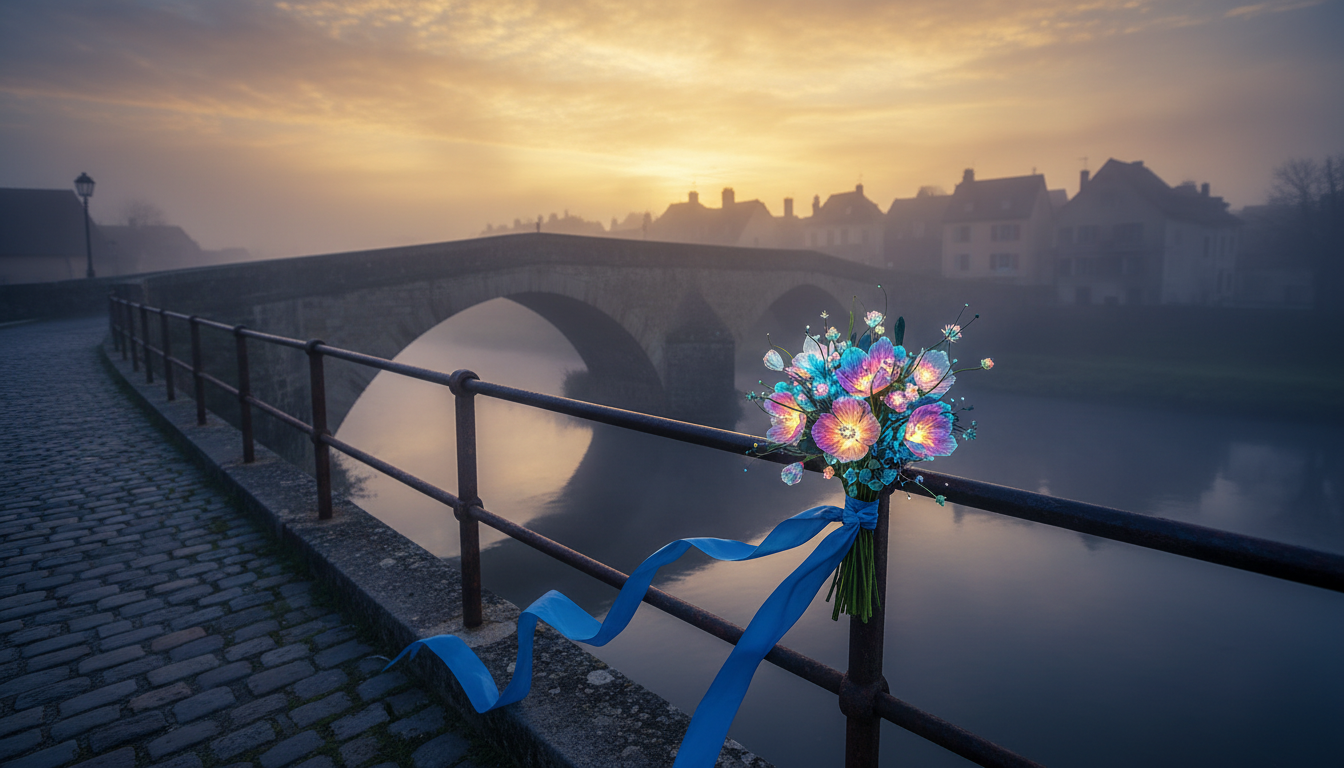
The fog usually claimed the Old Stone Bridge long before the sun had a chance to argue. In the valley of Oakhaven, the river below ran cold and silent, a silver ribbon that seemed to swallow sound as easily as it swallowed the reflection of the weeping willows. For most of the townspeople, the bridge was simply a means to an end, a sturdy arch of granite that connected the sleepy residential district to the bustling market square. It was grey, ancient, and unremarkable, save for one distinct, recurring miracle.
Every morning, without fail, a bouquet of fresh flowers appeared tied to the central railing.
These were not the sort of flowers one could pick up at the local grocer, nor were they the wildflowers that grew in the unruly patches along the riverbank. They were impossibly vibrant, often out of season, and possessed a fragrance that seemed to cut through the heavy dampness of the morning mist like a warm knife. In the dead of winter, when the frost coated the cobblestones in a treacherous white glaze, the bridge would boast a bundle of sun-drenched marigolds. In the scorching heat of July, cool, dewy snowdrops would hang there, defying the temperature.
Clara, a librarian with a penchant for noticing things others ignored, had been tracking the phenomenon for nearly a year. Her walk to the library took her over the bridge at seven-thirty each morning. By then, the flowers were always there. Sometimes they were tied with a simple piece of twine; other times, a ribbon of blue silk. There was never a note. There was never a name. Just the flowers, standing vigil over the rushing water.
The town of Oakhaven was not prone to magic, or at least, that is what its inhabitants believed. They were practical people who worried about harvest yields and roof leaks. Yet, the bridge had become a quiet focal point, a subtle interruption in the mundane rhythm of daily life. Commuters would pause, if only for a second, to inhale the scent of lilacs in December. Children would point, their breath puffing in the cold air, marveling at the splash of color against the grey stone. It was a shared secret, a collective comfort that nobody dared to question too loudly, for fear that the magic might evaporate under scrutiny.
Clara, however, felt a pull that went beyond simple curiosity. She felt a kinship with the invisible benefactor. Her own life had become somewhat monochrome lately, washed out by the routine of cataloging books and quiet evenings spent alone. The flowers were the brightest part of her day, a reminder that beauty could exist without explanation, that care could be given without expectation of thanks.
One Tuesday in late autumn, when the wind was biting enough to numb the fingers, Clara found a bundle of blue hydrangeas. They were her grandmother’s favorite. The sight of them, lush and brimming with life against the rusted iron railing, brought a sudden, sharp tear to her eye. It was then she decided she needed to know. Not to expose the person, and certainly not to stop them, but simply to witness the moment the grey world turned into something else.
She woke the next morning while the sky was still the color of bruised slate. The town was asleep, the chimneys just beginning to exhale their first tendrils of smoke. Clara dressed in her warmest coat, wrapped a scarf twice around her neck, and set out. The air was crisp, smelling of wet earth and impending rain. She did not stand on the bridge itself; instead, she positioned herself on the riverbank, hidden beneath the overhang of an ancient oak tree that offered a clear view of the central arch.
Time moved slowly in the cold. The river murmured, a low, continuous conversation with the rocks. For a long while, there was nothing but the shifting mist. Then, just as the horizon began to bleed a pale gold, a figure emerged from the direction of the woods.
It was not a ghost, nor a spirit of the river. It was a man, elderly and stooped, wearing a tweed coat that had seen better decades. He walked with a slow, deliberate gait, using a walking stick that clicked rhythmically against the stones. Clara recognized him vaguely—Mr. Abernathy, a man who lived on the edge of town and mostly kept to himself. He was known for fixing clocks and mending broken ceramics, a man of precise, quiet talents.
Clara watched, holding her breath. Mr. Abernathy reached the center of the bridge and stopped. He did not carry a bouquet. His hands were empty, resting on the handle of his cane. Clara felt a pang of confusion. Had she missed it? Had he already been there?
Then, the impossible happened. Mr. Abernathy reached into the deep pocket of his coat and pulled out what looked like a handful of dry, withered twigs. They were brown and brittle, lifeless remnants of a forgotten season. He held them gently, cradling them against his chest for a moment, his head bowed as if in prayer or conversation. When he lifted his hand to the railing, the morning light seemed to catch on his fingers.
As he tied the bundle to the iron bars, the twigs trembled. A soft, green hue flushed through the stems. Leaves unfurled in seconds, spiraling outward like a time-lapse video played in real-time. Buds appeared, swelling and bursting open into magnificent, velvety roses the color of a sunset. The transformation was silent, absolute, and undeniably real. The scent of the roses drifted down to the riverbank, sweet and heavy.
Clara stood frozen. She had expected a secret admirer, a grieving widower buying flowers from a market in the next town over. She had not expected this quiet alchemy. Mr. Abernathy patted the petals tenderly, the way one might pat the hand of an old friend, and then continued his walk across the bridge, disappearing into the mist on the other side.
She did not confront him. Some mysteries are not meant to be solved with words. Instead, Clara walked up to the bridge after he had gone. The roses were vibrant, their petals soft and cool to the touch. They pulsed with a faint, residual warmth. Standing there, Clara understood that the magic wasn’t just in the blooming; it was in the intent. Mr. Abernathy wasn’t just decorating a bridge; he was healing it. He was pouring life into a structure of cold stone, perhaps ensuring it could carry the weight of the town for another day.
Weeks turned into months, and the ritual continued. Clara never told a soul what she saw. However, the monochrome of her own life began to shift. She started waking up earlier, not to spy, but to simply be awake when the magic happened. She began to notice other small miracles in Oakhaven—the way the bakery smelled of vanilla even when the ovens were off, how the stray cats always seemed to find shelter before a storm, how the streetlamps flickered in time with the church bells.
One morning, the bridge was empty. No flowers. No Mr. Abernathy. The stone felt colder than usual, the grey more oppressive. Clara waited, worry gnawing at her. The town felt heavy, as if the gravity had been turned up.
She found him later that day, sitting on a bench in the park, looking frail. His hands, usually steady, were trembling slightly. He looked up as she approached, his eyes bright and knowing. He didn’t seem surprised to see her.
“The frost was hard on the joints today,” he said, his voice like dry leaves. “My hands couldn’t convince the stems to wake up.”
Clara sat beside him. She didn’t ask how he knew that she knew. “They are sleeping?”
“Deeply,” he replied. “They need a lot of hope to wake up in this cold. Sometimes, I don’t have enough to spare.”
Clara reached into her bag. She had been carrying a book of pressed botanicals, but instead, she pulled out a single, fresh tulip she had bought from a florist that morning, intending to brighten her desk. It was red, simple, and ordinary. It possessed no magic other than the fact that it had grown from the earth.
“What if,” Clara said softly, “we combined them? My flower, and your intent?”
Mr. Abernathy smiled, and the lines in his face deepened into a map of kindness. He took the tulip. He held it with his withered twigs. “It helps,” he whispered. “To have a catalyst.”
They walked to the bridge together. It was late in the day, and the commuters were rushing home, heads down against the wind. Mr. Abernathy tied the tulip and the twigs to the railing. Clara placed her hand over his. She thought of the library, of the stories of dragons and heroes, of the quiet resilience of the town, and of the grandmother who loved hydrangeas. She poured every ounce of warmth she had into that touch.
The twigs shivered. They wound themselves around the stem of the tulip, drawing strength from it. Slowly, brilliantly, they bloomed into white lilies, surrounding the red tulip in a crown of light. The bridge seemed to sigh, the stone warming beneath their hands.
The tradition continued, but it changed. It was no longer a solitary act. Every morning, Clara met Mr. Abernathy at the bridge. Sometimes she brought a flower, sometimes a fern, sometimes just her presence. The bridge became a garden of the impossible, a testament to the idea that magic is simply what happens when grief and hope are shared between two people.
The townspeople of Oakhaven never found out the source of the flowers. They simply accepted that their bridge was blessed, that the river was guarded, and that no matter how harsh the winter, there would always be something blooming in the mist, waiting to remind them that spring was not a season, but a promise kept every single morning.