
The grayness had arrived slowly, accumulating like dust on a windowsill. Elena hadn’t noticed it happening until one Tuesday evening, walking home from the train station, when she realized she couldn’t remember the last time she had genuinely looked at the sky. The world had become a series of obligations, a checklist of tasks that refreshed itself every morning at dawn. Her feet moved against the pavement in a rhythm that felt entirely automatic, carrying a body that felt less like a vessel for a soul and more like a machine for commuting.
It was November, and the fog was rolling in off the river, thick and smelling of wet stone. Usually, Elena would have zipped her coat higher and hurried toward the safety of her apartment complex. But tonight, a flicker of color caught the corner of her eye. It was an impossible color—a deep, burning amber that cut through the desaturated gloom of the city street.
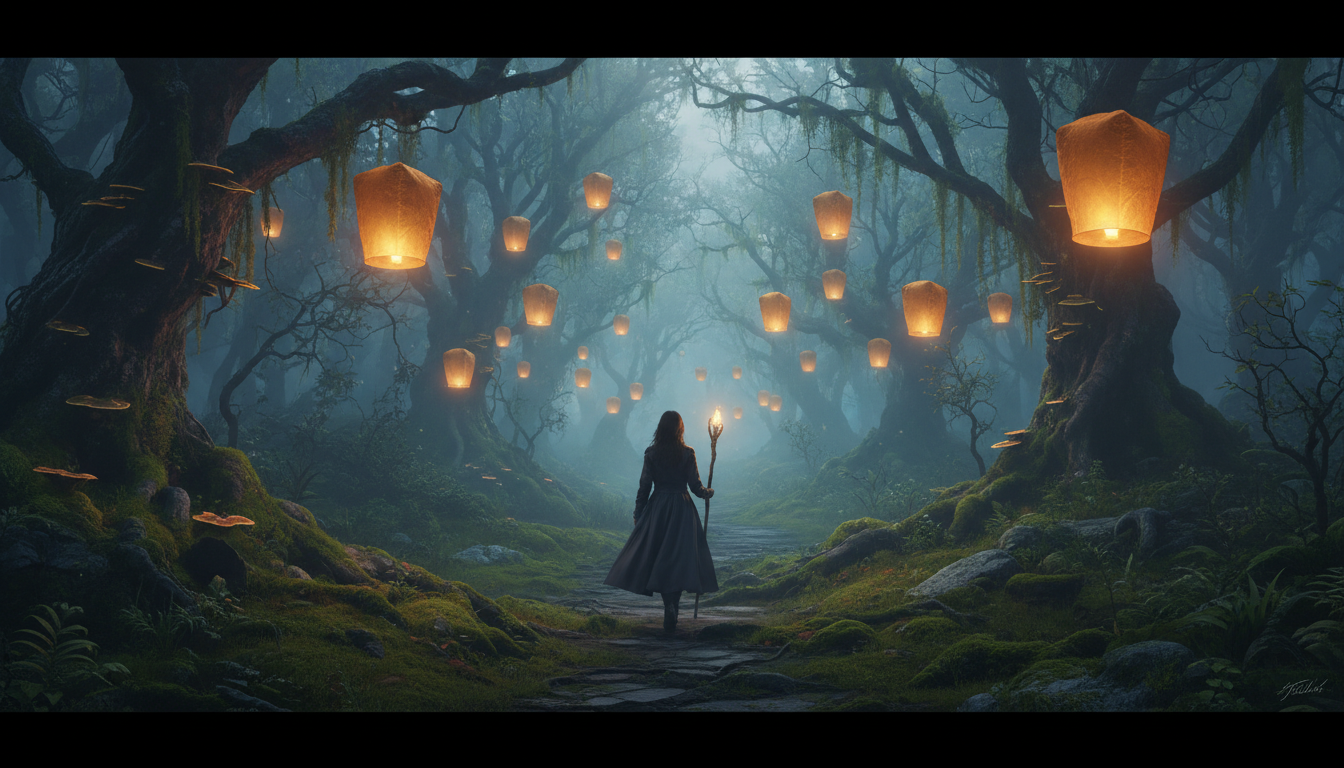
She stopped. To her left, where there should have been a narrow alleyway cluttered with recycling bins, there was a path. It wasn’t paved. It was covered in soft, dark moss, and hovering just above the ground was a paper lantern. It glowed with a gentle, pulsing warmth, bobbing slightly in a breeze that Elena couldn’t feel on her cheeks.
Logic dictated that she turn away. Logic said this was a trick of the light, or an art installation, or perhaps a sign of exhaustion. But her chest, which had felt tight for months, suddenly expanded. Without consulting her schedule or her better judgment, Elena stepped off the concrete and onto the moss.
The First Light of Memory
The sounds of the city—the distant sirens, the hum of traffic, the chatter of pedestrians—vanished the moment she crossed the threshold. The silence here wasn’t empty; it was heavy and expectant, like the air in a library before a book is opened. The first lantern drifted forward as if acknowledging her presence, then floated further down the path. A few yards away, a second lantern ignited. Then a third.
Elena followed. The air here smelled different. It smelled of woodsmoke and vanilla, a scent that tugged at something behind her ribs. As she passed the second lantern, a memory washed over her, vivid and sudden. She saw herself at seven years old, sitting at a kitchen table covered in newspaper, painting a cardboard castle. She felt the sticky texture of the paint and the overwhelming, dizzying joy of creating something from nothing. She remembered the belief that the cardboard castle was impenetrable.
She took a sharp breath. She hadn’t thought of that kitchen in twenty years. The memory warmed her, chasing away the chill of the November fog. She walked faster, drawn to the next light.
The path wound through trees that were too tall and ancient for the city limits. Their branches formed a cathedral ceiling, shielding her from the sky. The fourth lantern hung from a low bough. As her shoulder brushed against its glow, another scene bloomed in her mind. She was sixteen, standing on a stage, her knees shaking, her voice cracking, but then stabilizing into a clear, strong note. It was the memory of bravery. It was the memory of fear being conquered by desire.
Elena realized then that the grayness of her life hadn’t been an addition, but a subtraction. She had slowly shed these parts of herself—the creator, the performer, the believer—in favor of the employee, the tenant, the adult. The lanterns weren’t leading her somewhere new; they were leading her back.
The Clearing in the Woods
The trail continued for what felt like hours, though her legs felt no fatigue. With each light she passed, a layer of numbness peeled away. She remembered the thrill of her first solo trip, the taste of blackberries in late summer, the specific ache of a heartbreak that eventually taught her resilience. The path was a timeline, illuminated in reverse, stripping away the cynicism that had calcified around her heart.
Finally, the trees broke. The trail ended at the edge of a circular clearing. The grass here was knee-high and silver in the moonlight, swaying gently. In the center of the clearing stood a single, massive willow tree, its branches draping down like curtains. Suspended from every branch were hundreds of tiny lanterns, swaying in unison.
Beneath the tree sat a woman. Her back was to Elena. She wore a coat that looked like Elena’s, but her posture was different—relaxed, shoulders down, head tilted back as if observing the stars.
Elena approached slowly, the grass whispering against her jeans. She knew, with the instinctive logic of a dream, who the woman was. She sat down beside her. The woman turned. It was her face, but softened. The worry lines between the brows were gone; the eyes were bright and curious. It was the version of Elena who hadn’t forgotten to look at the sky.
They didn’t speak. There was no need for words in a place woven from light and memory. The other Elena simply reached out and took her hand. A rush of warmth traveled up Elena’s arm, settling in the center of her chest. It wasn’t a magical transfer of power; it was a re-calibration. It was the feeling of coming home after a long, cold journey.
For a long time, they sat there under the canopy of lights. Elena allowed herself to just exist. She wasn’t a project manager. She wasn’t a daughter or a friend or a list of obligations. She was simply a heartbeat, a witness to beauty, a collection of stories held together by skin and bone.
The Return to Morning
The glow of the lanterns began to dim, not fading into darkness, but softening into the pale gold of dawn. The willow tree became translucent, the silver grass misted over. The woman beside her squeezed her hand once, a solid, grounding pressure, and then dissolved into the morning light.
Elena blinked. The smell of woodsmoke was replaced by the scent of damp pavement and coffee. She was standing at the entrance to her apartment building. Her keys were in her hand. The streetlights were flickering off as the sun crested the horizon, painting the city skyline in shades of apricot and violet.
She looked down at her shoes. There was a smudge of dark, fresh moss on the toe of her left boot.
A neighbor walked out of the building, checking his watch, his face set in a grim line of determination for the day ahead. He nodded at her, barely making eye contact, rushing toward the train.
Elena didn’t rush. She stood on the step and watched the sunrise. The grayness was gone. The checklist remained, the emails would still be waiting, and the rent was still due, but the weight of it all had shifted. She touched the center of her chest, where the warmth from the clearing still hummed, steady and bright. She had walked into the dark to find the light, and now, she carried it with her. She opened the door, not to escape the world, but to enter it fully, ready to begin.