
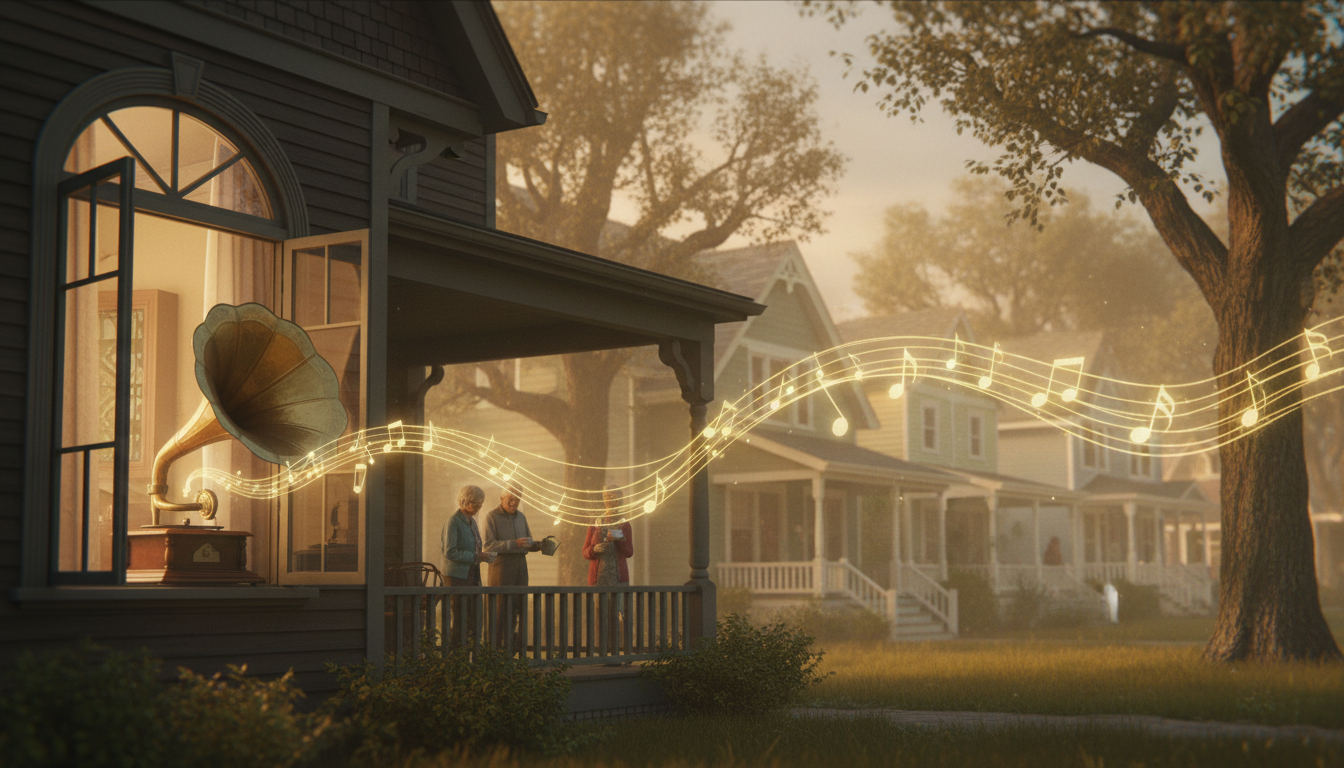
In the quiet corner of Oakhaven, where the oak trees arch over the street like a cathedral ceiling, time behaves differently on Sundays. During the week, the neighborhood is a blur of slamming car doors, rushing commuters, and the sharp, staccato rhythm of modern life. But when the church bells fade on Sunday morning, specifically at eleven o’clock, a hush falls over the pavement. The wind seems to hold its breath. The stray cats pause mid-stretch. And then, it begins.
It starts as a faint vibration, a hum that you feel in your chest before you hear it with your ears. Then, the melody unfurls. It is always the same song—a slow, orchestral waltz that sounds as if it is being played through layers of velvet and time. It is not digital; there is the distinct, warm crackle of a needle finding a groove, a soft hiss of static that sounds like rain on a tin roof.
For years, nobody knew exactly which house it came from. The acoustics of Oakhaven are tricky; the sound seems to bounce off the brick facades and filter through the leaves, arriving at every doorstep simultaneously. It doesn’t matter where it originates. What matters is what it does.
When the music starts, Arthur, who lives at number forty-two, puts down his newspaper. Arthur has lived alone since his wife passed three winters ago. His house is silent, filled with the dust of memories he is afraid to disturb. But when that waltz drifts through his open window, the heaviness in his chest lightens. He closes his eyes and can almost smell the lavender perfume she used to wear. For the duration of the song—three minutes and forty-five seconds—he is not a widower in a drafty house. He is a young man in a dance hall, his hand resting on the waist of the woman he loves.
Two doors down, the young mother, Sarah, stops scrubbing the dishes. Her twins are usually a whirlwind of chaos, a tornado of plastic toys and high-pitched shrieks. But when the Sunday song plays, they stop. They sit on the rug, mesmerized, watching the dust motes dance in the shafts of sunlight that seem to brighten in rhythm with the violins. Sarah leans against the sink, drying her hands on her apron, and feels a knot of tension loosen at the base of her neck. The song tells her that everything is okay, that the chaos is temporary, that there is beauty in the mess.
This is the magic of the Sunday waltz. It doesn’t just play music; it suspends reality. Arguments over property lines or unreturned tools are forgotten. The grumpy man at the end of the cul-de-sac, Mr. Henderson, who chases kids off his lawn with a broom, has been seen standing on his porch, eyes closed, conducting an invisible orchestra with a trembling finger. The song strips away the armor everyone wears to survive the week. It reveals the soft, beating heart of the neighborhood.
The Silence That Spoke Louder
The ritual continued for seven years, as reliable as the rising sun. Until one Sunday in late October, when the leaves had turned the color of burnt sugar and the air carried the crisp bite of frost. Eleven o’clock came. The neighborhood waited. Arthur poured his tea. Sarah hushed the twins. Mr. Henderson stepped onto his porch.
Eleven-oh-one. Eleven-oh-five.
Silence. A heavy, hollow silence that felt wrong, like a missing step on a staircase. The birds chirped, but they sounded shrill. The wind blew, but it felt cold.
Arthur looked out his window. He saw Sarah stepping onto her lawn, looking left and right. He saw Mr. Henderson looking at his watch, tapping it as if time itself had broken. Slowly, tentatively, doors opened. People who usually only nodded politely to one another while taking out the trash began to drift toward the street. They gathered in the center of the road, a confused congregation denied their sermon.
“Is it the power?” Sarah asked, wrapping a cardigan tighter around herself.
“No, my lights are on,” Arthur said. His voice sounded rusty; he hadn’t spoken to anyone since Friday at the grocery store.
“It’s the music,” Mr. Henderson grumbled, though his eyes lacked their usual fire. “Where is the music?”
They realized then that they had all been sharing this secret gift, assuming they were the only ones who cherished it. The collective loss pulled them together. Guided by a sudden, shared intuition, they looked toward the Victorian house on the corner—the one with the overgrown ivy and the windows that always seemed to reflect the sky.
It was the home of Mrs. Gable. She was a recluse, a woman who ordered her groceries for delivery and was rarely seen without a wide-brimmed hat shadowing her face. The neighbors realized, with a pang of guilt, that none of them had spoken to her in years.
The Source of the Melody
Arthur took the lead, walking up the cracked cobblestone path. The others followed, a procession of worried souls. He knocked on the heavy oak door. It swung open slightly; it wasn’t latched.
“Mrs. Gable?” Arthur called out. “Elara?”
There was no answer. They stepped inside. The house smelled of old paper, beeswax, and dried roses. In the parlor, sitting by a bay window that overlooked the street, was a massive, vintage phonograph. Its brass horn caught the sunlight, gleaming like gold. In an armchair beside it sat Mrs. Gable. She looked peaceful, her head tipped back against the velvet headrest, her hands folded in her lap. She was asleep, or so it seemed at first.
But the stillness was too absolute. Arthur checked for a pulse and found none. She had slipped away, perhaps only an hour before, sitting in her favorite chair, waiting for eleven o’clock.
On the turntable of the phonograph, the needle sat resting in the run-out groove of a record. The label was faded, but the title was legible: The Waltz of the Sunday Morning.
The neighbors stood in respectful silence. Sarah wiped a tear from her cheek. Mr. Henderson took off his cap and held it to his chest. They had lost the DJ of their lives, the woman who, unbeknownst to them, had been knitting their souls together every week with a thread of vinyl and sound.
“She must have wound it every week,” Arthur whispered. “Just for us. Or maybe for herself, and we were just lucky enough to hear it.”
The silence of the house felt unbearable. It threatened to spill out into the street and swallow the neighborhood whole. They couldn’t leave her like this, in the quiet.
Arthur looked at the phonograph. It was a hand-cranked model, needing no electricity, only human intention. He reached out, his hand trembling slightly, and took the crank. He turned it. Crank, crank, crank. The resistance of the spring felt like winding the heart of the world back up.
He lifted the heavy tone arm and gently placed the needle at the edge of the record.
The Tradition continues
The crackle hissed—the sound of rain on a tin roof. And then, the music swelled. The waltz filled the room, bounced off the high ceilings, drifted out the open door, and flooded the street.
It was sadder this time, but also sweeter. It was a goodbye and a hello.
In the weeks that followed, the neighborhood changed. They didn’t retreat back into their separate lives. The music had become a responsibility they shared. A schedule was made, taped to the refrigerator in Sarah’s kitchen. Every Sunday, a different neighbor had the key to Mrs. Gable’s house (which her distant nephew, after hearing the story, decided to leave exactly as it was, calling it a “community heritage site”).
One week, it was Sarah who went in to wind the crank. The next, it was Mr. Henderson, who wore his best Sunday suit for the occasion. The week after, it was Arthur.
The music still plays at eleven o’clock. The magic hasn’t faded; if anything, it has grown. Now, when the song drifts through the windows, the people of Oakhaven don’t just stop and listen. They step out onto their porches. They wave to one another. Sometimes, Arthur walks down the street to Sarah’s house, and they listen together while the twins dance in circles on the grass.
The song is no longer a mystery falling from the sky. It is a choice. It is a promise they keep to one another, a reminder that even in a world that rushes constantly forward, there is always time to stop, to listen, and to remember that we are all dancing to the same silent rhythm, waiting for someone to wind the crank.