
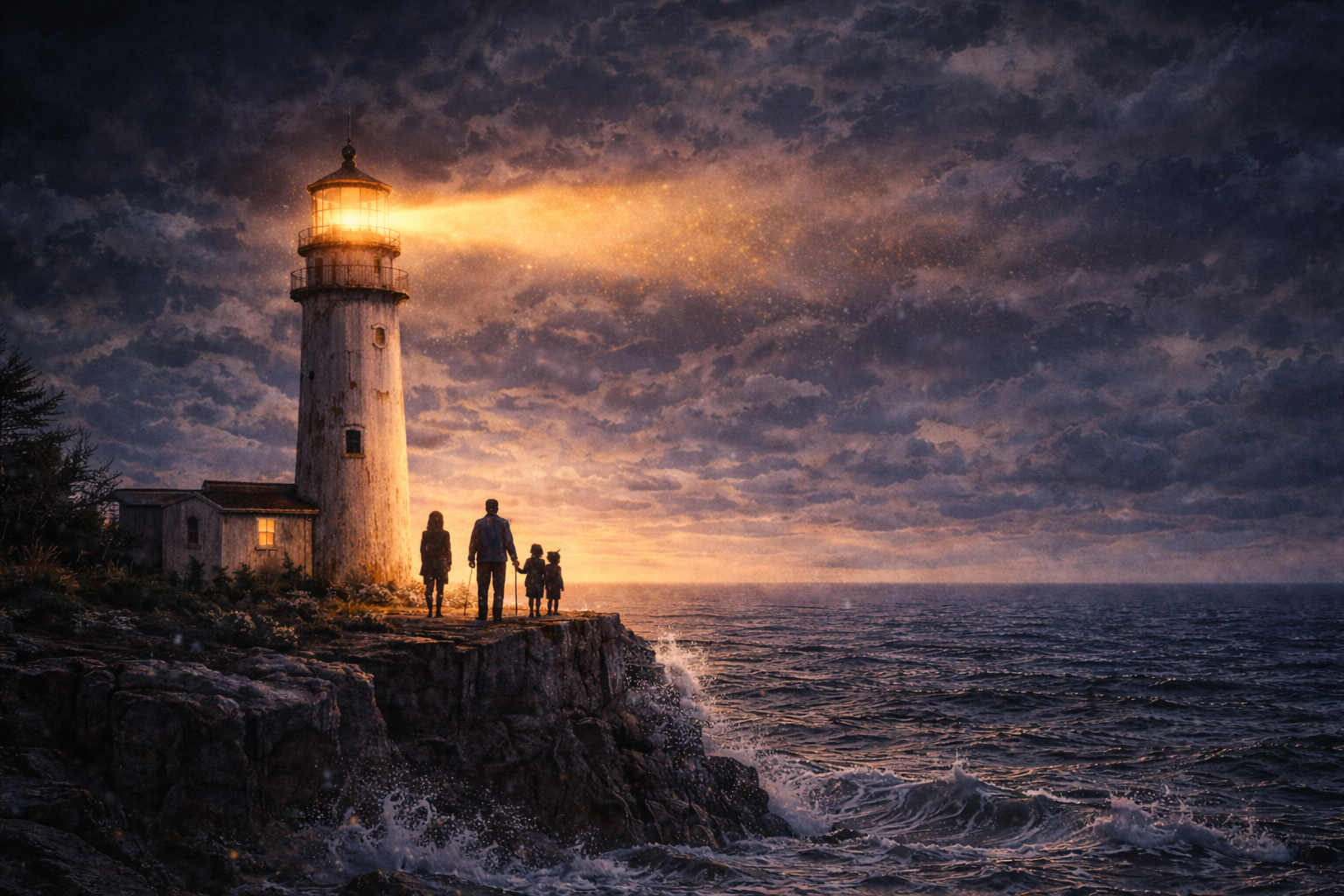
No one ever called it a working lighthouse anymore.
It stood on the edge of the cliffs like an old habit the town hadn’t quite let go of—white paint peeling, glass panes clouded by salt and time, the metal railing forever cold to the touch. Officially, it had been decommissioned decades ago, replaced by modern navigation systems and satellite guidance.
And yet.
Every night at exactly 9:17 p.m., the light came on.
Not a sweeping beam meant to warn ships away from rocks, but a steady, soft glow—warm, almost amber—that reached inland more than it ever reached the sea.
Most people in Havenridge barely noticed anymore. The lighthouse was just… there. A constant. Like the sound of waves or the smell of salt in the air.
But for some, it meant everything.
Mara Ellison first noticed the light the night her life quietly unraveled.
She had moved to Havenridge only three weeks earlier, dragging two suitcases and a box of books into a rented apartment above a closed-down florist. The move wasn’t planned the way people imagine fresh starts to be planned. It was more of a retreat than an arrival.
That night, she sat on the floor with her back against the couch, phone dark in her hand, surrounded by unopened boxes. The silence pressed in on her ears.
Then the room changed.
A faint golden glow slipped through the window, brushing the far wall like a held breath.
Mara looked up.
The lighthouse.
She frowned. “You’re not supposed to be on,” she muttered.
The glow didn’t flicker. It didn’t sweep. It simply… stayed.
Something in her chest loosened.
She slept that night for the first time in weeks.
Havenridge locals would tell you the lighthouse had always been strange—but never threatening. If anything, it felt attentive, as if it noticed people rather than places.
Old Mr. Keane, who ran the bait shop, swore the light came on brighter the year his wife passed. He’d sit on the bench outside after closing, and somehow the glow always reached him.
A teenage girl once admitted she only stopped crying on the cliffs because the light turned on just as she was about to give up and go home.
A letter had arrived at the town council years earlier—unsigned—simply saying:
Thank you for the light. It reminded me to stay.
The mayor filed it away without comment.
Mara started walking to the cliffs every evening.
Not because she believed in stories or miracles, but because the air there felt cleaner. Because the lighthouse didn’t ask anything of her. Because when the light came on, it felt like someone had remembered she existed.
She wasn’t the only one.
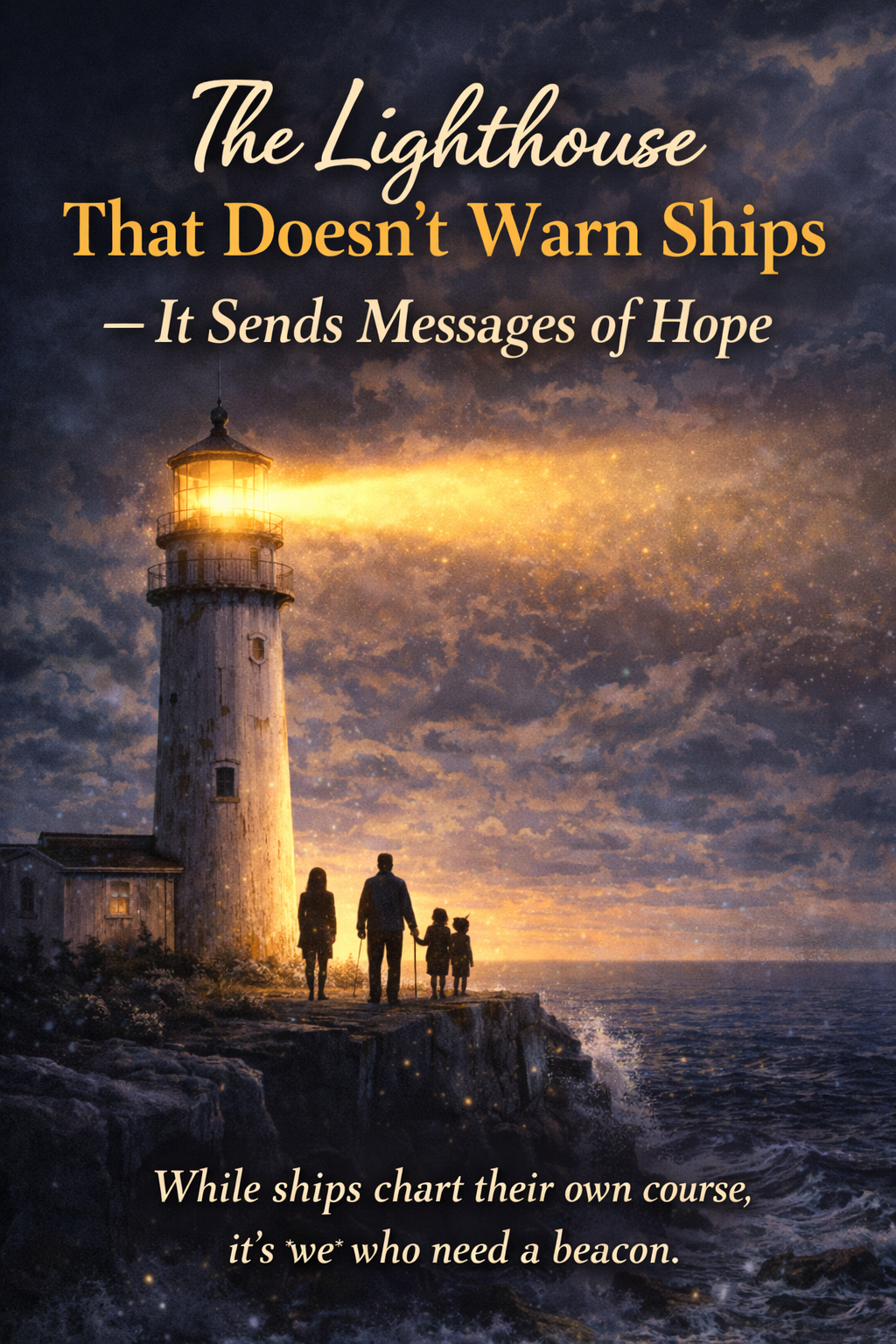
Over time, she began to notice familiar faces at dusk: a man with a cane who always arrived early, a young mother pushing an empty stroller, a woman who painted the ocean every night and never spoke.
They didn’t talk much. No one needed to.
At 9:17, the light would glow, and everyone would breathe a little easier.
One night, Mara finally asked the man with the cane.
“Do you know why it turns on?”
He smiled faintly. “No idea.”
“Then why do you come?”
He tapped his chest lightly. “Because it feels like someone’s saying, ‘You made it through today.’”
The change came quietly.
Mara noticed it first in herself.
She started unpacking boxes. Answering emails. Cooking meals instead of eating cereal from the box. The light didn’t fix her life—it didn’t promise answers—but it reminded her that time was still moving forward, and so could she.
One evening, she stayed later than usual, long after the light had faded.
That was when she saw someone climb the lighthouse steps.
A woman. Elderly. Slow but determined.
Mara hesitated, then followed.
Inside, the lighthouse smelled of dust and old iron. The woman stood near the lantern room, resting her hands on the railing.
“You’re not supposed to be up here,” Mara said gently.
The woman smiled. “I know.”
“Then why—”
“I used to be the keeper,” she said. “A long time ago.”
Mara blinked. “But it’s automated.”
The woman laughed softly. “Now it is.”
She looked out over the dark water. “Back then, I used to adjust the light manually. But when they shut it down… something felt unfinished.”
“So you turn it on?” Mara asked.
The woman shook her head. “I stopped doing that years ago.”
“Then who—”
“I think,” the woman said slowly, “it learned.”
They stood in silence.
“You know,” the woman added, “the light was never meant just for ships. Sailors knew where they were going. It was the people on shore who needed reminding.”
Mara felt tears sting her eyes.
A storm rolled in that night—hard, sudden, violent. Power went out across Havenridge. Windows rattled. The sea roared.
And still, at 9:17, the lighthouse glowed.
Brighter than ever.
Emergency crews later said it made no sense. The lighthouse wasn’t connected to the grid. There was no backup generator.
And yet.
People saw it from miles away.
And something in them held.
Weeks passed. Then months.
Mara stayed.
The painter finished her first canvas and smiled when she signed it.
The man with the cane stopped needing it.
The young mother came back one evening—this time holding a child’s hand.
The lighthouse kept shining.
Not every night. But always when someone needed it most.
No announcements. No explanations.
Just a quiet light on a cliff, reminding people that even when nothing else makes sense…
They are not alone.