
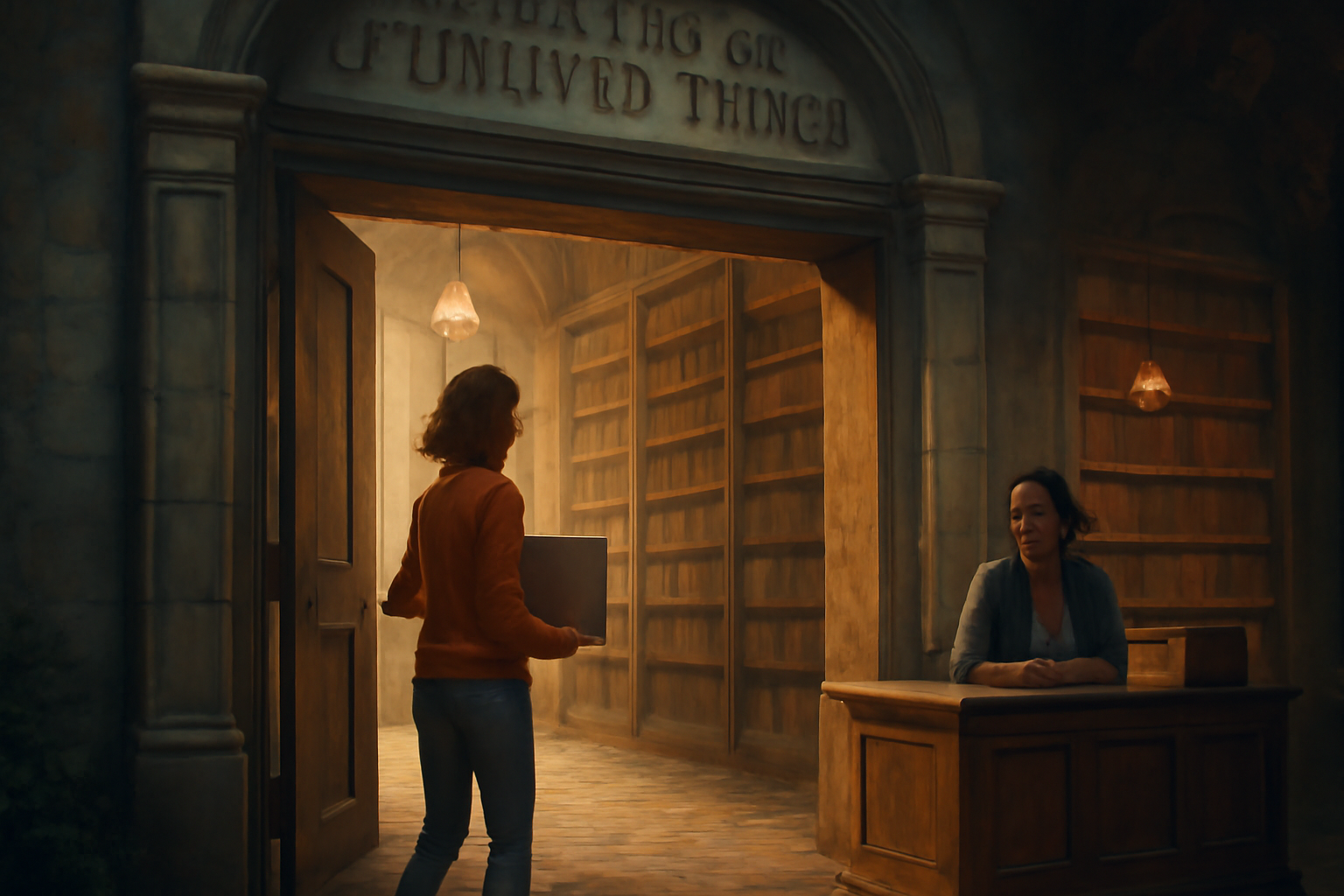
The library appeared to Lena on a day when she felt like a ghost in her own life.
It was a Tuesday, which seemed unfair; Tuesdays were supposed to be quietly forgettable, not life-altering. The morning had started like every other — alarm at 6:15, coffee that tasted faintly of cardboard, a commute made of brake lights and the glow of other people’s phones. At 8:59, she’d sat down at her desk in the insurance office, just in time to answer her first politely panicked email of the day.
By noon, her eyes ached from staring at spreadsheets. Her headset pressed a permanent groove into her hair. She’d eaten half a granola bar and forgotten the other half in a drawer.
“This is fine,” she’d told herself. “This is what adults do.”
They swallowed their dreams and called it practicality.
They tamped down the weird, wild parts of themselves and saved them for “later,” like some kind of emotional leftovers.
Later, she thought, she would write again. Later she would travel. Later she would learn the piano, or how to throw clay, or how to stand in front of people and read a story and not shake.
Later.
By three o’clock, “later” felt like a country she no longer had a passport for.
She left the office early on a flimsy excuse about a dentist appointment, the lie tasting like guilt and relief combined. Instead of going home, she walked.
She didn’t mean to walk as far as she did.
She just let her feet choose.
They led her out of the city center, past streets she knew by heart, past the bus stop where she always stood in the rain, past the park with its tired fountain and gum-spotted benches.
Clouds rolled in, turning the afternoon light soft and uncertain.
That’s when she saw the alley.
She’d passed this block a hundred times. A bakery on the corner. A stationery shop with carefully curated pens. An old brick wall with ivy in summer and bare clinging vines in winter.
There had never been an alley between the bakery and the wall.
Today, there was.
Narrow. Shadowed. Paved with old stones worn smooth by feet that couldn’t possibly have walked there, because it hadn’t existed yesterday.
At the far end of the alley, something glowed.
Lena stopped.
“You’re tired,” she muttered. “You’re hallucinating a cut-through because your brain wants a shortcut home.”
But her feet stepped forward anyway.
The farther she walked, the quieter the city became. The sound of traffic faded. The chatter of people dimmed. Even the ever-present hum of her own anxious thoughts softened, like someone turning down the volume.
She reached the end of the alley.
And the world opened into a courtyard.
It was not big.
Four walls of old, honey-colored stone rose around a square of cobblestones. Vines climbed in careful spirals. A fountain trickled quietly in the center, water spilling from the pages of a stone book held in stone hands.
On the far side of the courtyard stood a building.
“Building” felt too small a word.
It had the shape of a library — tall arched windows, wide oak doors, a carved lintel. But it looked… older than the rest of the city. Older than the alley. Older than anything had any right to look, while still somehow radiating warmth instead of menace.
Words were carved above the door.
Lena squinted.
THE HOUSE OF UNLIVED THINGS
Her heart gave a small, confused thump.
A gust of wind pushed gently at her back, nudging her forward.
“Fine,” she whispered. “If this is how I die, at least it’ll be more interesting than answering emails.”
She grasped the iron handle and pulled the door open.
The smell hit her first.
Not dust, like old libraries.
Warm paper. Ink. A faint undertone of citrus and something that reminded her of late-night coffee.
Light pooled inside like honey.
Rows and rows of shelves stretched into shadowed distance, lined not with books — not only with books, at least — but with boxes and jars and objects of all shapes and sizes. Above, a mezzanine ringed the room, ladders leaning against it at odd angles.
A desk sat near the entrance, stacked with cards and a small brass bell.
Behind the desk sat a woman.
She looked up as Lena entered, her smile soft and unsurprised.
“Oh,” she said. “You found us. Good.”
Lena froze halfway in.
“Us?”
“The library,” the woman said. “And yourself, eventually.”
She wore a cardigan the color of oversteeped tea and had gray streaks in her hair that looked intentionally placed by a kind-hearted universe. Her eyes were… complicated. Layers of amusement and sadness and curiosity stacked together.
“Welcome to the House of Unlived Things,” she said. “I’m Imani. I do a bit of everything.”
Lena’s mouth was dry.
“Is this… real?” she asked.
Imani considered.
“Real enough to help,” she said. “Come in properly, dear. Doors like this don’t stay open for just anyone.”
The phrase “Stranger Danger” fluttered briefly through Lena’s mind, then gave up, overwhelmed by an equally strong sense that she would regret walking away for the rest of her life.
She stepped fully inside.
The door swung shut behind her with a soft click.
The outside world vanished. Or maybe it was just politely waiting.
“Right,” Lena said faintly. “So, you’re… a librarian? Of… unlived things?”
Imani’s smile deepened.
“Of forgotten dreams, postponed callings, abandoned plans, unwritten stories, unsung songs,” she said. “All the bits people drop along the road when life gets loud.”
Lena’s stomach twisted.
“You collect… dreams?”
“We hold them,” Imani corrected gently. “Collecting implies we keep. We’re more of a lost property office for the soul.”
Lena let out an incredulous laugh.
“This is—”
“Impossible?” Imani supplied.
“Exactly.”
“Mm.” Imani picked up a card, jotted something on it with a fountain pen. “And yet you’re here.”
“I’m having a breakdown,” Lena decided. “That’s it. Full, spectacular break with reality. My brain finally melted after too many spreadsheets.”
“It’s always spreadsheets,” Imani said sympathetically. “Or traffic. Or the third hour of a meeting that should have been an email. Sit.”
A chair appeared behind Lena.
She sank into it before she could argue.
The cushions were exactly the right firmness.
“People only find this place when a certain threshold is crossed,” Imani said. “When the weight of unlived things grows too heavy. When the deferred parts of them start making noise.”
She tapped her pen against her chin.
“Tell me, Lena Hart — what have you been postponing?”
Lena flinched.
“I never… told you my name.”
“Yes, you did,” Imani said kindly. “You told it to yourself when you walked up to the door. The library listens.”
Lena stared at her hands.
“I… used to write,” she said, the words feeling like contraband on her tongue.
“Stories.”
Imani’s eyes warmed.
“Yes,” she said. “You did.”
“How do you—?”
Imani stood, smoothing her cardigan.
“Come,” she said. “Let’s show you the section.”
They walked between shelves that hummed faintly, like beehives full of whispered words.
On some shelves, dreams looked like books — spines in every color, their titles shifting when she tried to read them.
On others, they were objects.
A violin with strings that vibrated to unheard melodies.
A pair of worn dance shoes, glowing faintly from the inside.
A jar full of folded paper cranes, each fluttering its wings.
“The music section,” Imani said. “The movement wing. The childhood vows corridor — that’s where the “When I grow up I’ll…”s tend to land.”
They passed a shelf where glass globes held miniature landscapes — deserts, oceans, mountains. Tiny figures walked those worlds.
“Travel dreams,” Imani said. “Some people carry them until the end. Others trade them in for something gentler when they realize home was what they were looking for all along.”
She turned a corner.
Stopped.
“Here we are.”
The sign at the end of the aisle read:
STORIES NEVER WRITTEN (DRAFTS OF THE HEART)
Lena’s breath caught.
Boxes and jars and books lined the shelves. Some glowed softly, some were dark, some flickered between the two like a decision undecided.
Imani ran a fingertip along the spines, humming quietly to herself.
“Let’s see,” she murmured. “Hart, Lena… ah.”
She pulled out a medium-sized box, the color of stormclouds just before they break.
Her name was written on the lid in her own handwriting.
“I didn’t put that there,” Lena whispered.
“Not consciously, no,” Imani said. “You dropped this box bit by bit. Every ‘I’ll do it later.’ Every ‘Who am I kidding.’ Every ‘What’s the point.’ The library catches what people try to throw away to make themselves more… acceptable.”
She opened the box.
Light spilled out.
Inside were pages.
Some were crisp, full scenes from stories she’d forgotten she’d begun. Others were only fragments — a single line of dialogue, a paragraph of description, a character’s name.
They pulsed faintly, like they were breathing in their sleep.
Lena reached out, trembling, and touched the top page.
A jolt shot up her arm — not painful, just shockingly familiar.
She saw herself at twelve, scribbling in a notebook under her duvet by flashlight. At seventeen, scrawling furious poetry on the back of chemistry handouts. At twenty-one, hunched over a café table, fingers flying over a laptop as she lost herself in a world that only existed because she was making it.
She saw the day she’d quit her creative writing group because someone had asked, “So what’s your plan with all this?” and she hadn’t had an answer that sounded respectable.
She saw the night she’d opened a new document, stared at the blank screen, then closed it and told herself, “You’re too tired. Tomorrow.”
Tomorrow had come and gone over and over until the want had dulled into an ache.
The pages in the box fluttered, as if sensing she was there.
She cupped them in her hands.
“I left you,” she whispered. “I’m sorry.”
Imani watched quietly.
“Unlived doesn’t mean dead,” she said. “It just means waiting.”
Lena swallowed hard.
“What happens to them?” she asked. “To these? To all of this?”
Imani’s gaze slid along the shelves.
“Some go back,” she said. “When someone remembers. When they pick up a paintbrush again, or enroll in a class, or dust off a piano.”
“And the others?”
“Some turn into something else,” Imani said. “A dream of writing might become a talent for listening to other people’s stories. A dream of performing might soften into a gift for making kids laugh in classrooms. Nothing is wasted, exactly. It just… changes shape.”
Lena clutched the pages.
“Can I… take them?”
Imani smiled, but there was a question in her eyes.
“You can,” she said. “If you’re willing to understand what that means.”
“What does it mean?”
“That you don’t get to pretend you don’t want this anymore,” she said gently. “You can’t take your dream back and keep treating it like an embarrassment. If you leave here with those pages, you’ll feel them. Tugging. Asking. You’ll be reminded, every time you sit down at your desk and open a spreadsheet instead of a document, that you chose not to be a ghost.”
“That sounds… hard,” Lena whispered.
“Living is,” Imani said. “But there are ways to make it less lonely.”
She touched the edge of the box.
A second, smaller box slid forward from the shelf beside it.
This one had a different name on it.
“Whose is that?” Lena asked.
“Someone who used to sit in an office two floors above yours,” Imani said. “She came here ten years ago. Took hers back. Now she runs a small community theater and teaches kids how not to be ashamed of wanting to be seen.”
Lena’s eyes stung.
“I don’t know if I’m brave enough,” she said.
Imani tilted her head.
“Do you want to be?”
Lena thought of her apartment, neat and lonely. Of her notebooks gathering dust. Of the way her chest tightened every time she saw someone else’s book in a shop window and thought, I used to…
“Yes,” she said, voice shaking. “I don’t want to keep leaving myself behind.”
Imani’s smile deepened.
“Then let’s check it out.”
At the desk near the entrance, there was no scanner, no computer.
Just a card catalogue drawer and a stamp.
Imani slid a card in front of Lena.
NAME: _____________________
ITEM(S) CLAIMED: _____________________
AGREEMENT: I understand that by reclaiming these unlived things, I invite them to take up space in my life again.
Lena stared at the last line.
“What if I fail?” she asked.
Imani uncapped the stamp.
“What if you succeed?” she countered.
Lena let out a breath that felt like it had been trapped for years.
She wrote her name.
She wrote: “Stories I haven’t given up on (even when I pretended I had).”
Imani stamped the card.
“That’s all contracts are,” she said. “A promise to show up. Not a guarantee of outcome.”
She slid the box of pages toward Lena.
“Take them,” she said. “Leave some room in your bag. They tend to expand once they remember they’re wanted.”
Lena hugged the box to her chest.
The paper felt warm.
“I’m scared,” she admitted.
“Good,” Imani said. “Fear means you’re touching something that matters.”
She walked Lena back to the door.
“Will I be able to come back?” Lena asked.
“The library is… shy,” Imani said. “It appears when needed, not when hunted. But you won’t need this place in the same way once you’ve started living the things you left here.”
The door creaked as she pushed it open.
The alley beyond looked the same as when Lena had entered.
The city sounds drifted in, slightly muted.
“Lena?” Imani said gently.
She turned.
“Yes?”
“One more thing.”
Imani held out a small, worn library card.
It had her name on it.
Beneath, in smaller letters:
ADMISSION GRANTED:
For Acts of Gentle Courage
“Whenever you doubt you’re allowed to want what you want,” Imani said, “look at that. Remind yourself you have a card on file.”
Lena laughed, tears in her eyes.
“Thank you,” she said. “For… saving these. For keeping them safe when I didn’t.”
Imani’s gaze softened with something like pride.
“Thank you for coming back for them,” she said.
Lena stepped through the door.
The air changed.
She looked back.
The courtyard was empty.
No fountain.
No stone walls.
No library.
Just the brick wall with its clinging vines and the side of the bakery, smelling of fresh bread.
For a moment, panic fluttered in her chest, like she’d lost something again.
Then she looked down at the box in her arms.
It was still there.
Pages. Warm. Waiting.
When she got home, she put the box on her kitchen table.
She made tea.
She sat.
For a long time, she just… looked at it.
Fear sat on one shoulder.
What if you’re terrible?
What if no one cares?
What if you waste all this time?
Hope sat on the other.
What if you’re not?
What if you care?
What if this time isn’t wasted if it’s yours?
Lena opened the box.
She chose one page at random — a scene about a woman who finds a door in an alley that shouldn’t exist.
She smiled, shaky but real.
“Let’s see what you were meant to be,” she whispered.
She picked up a pen.
And, slowly, gently, imperfectly,
she began to write
the story of someone
who had almost given up on herself
and then, one ordinary Tuesday,
walked into a library
where forgotten dreams went to wait their turn
and finally said,
“I’m ready. It’s yours again. And mine.”