
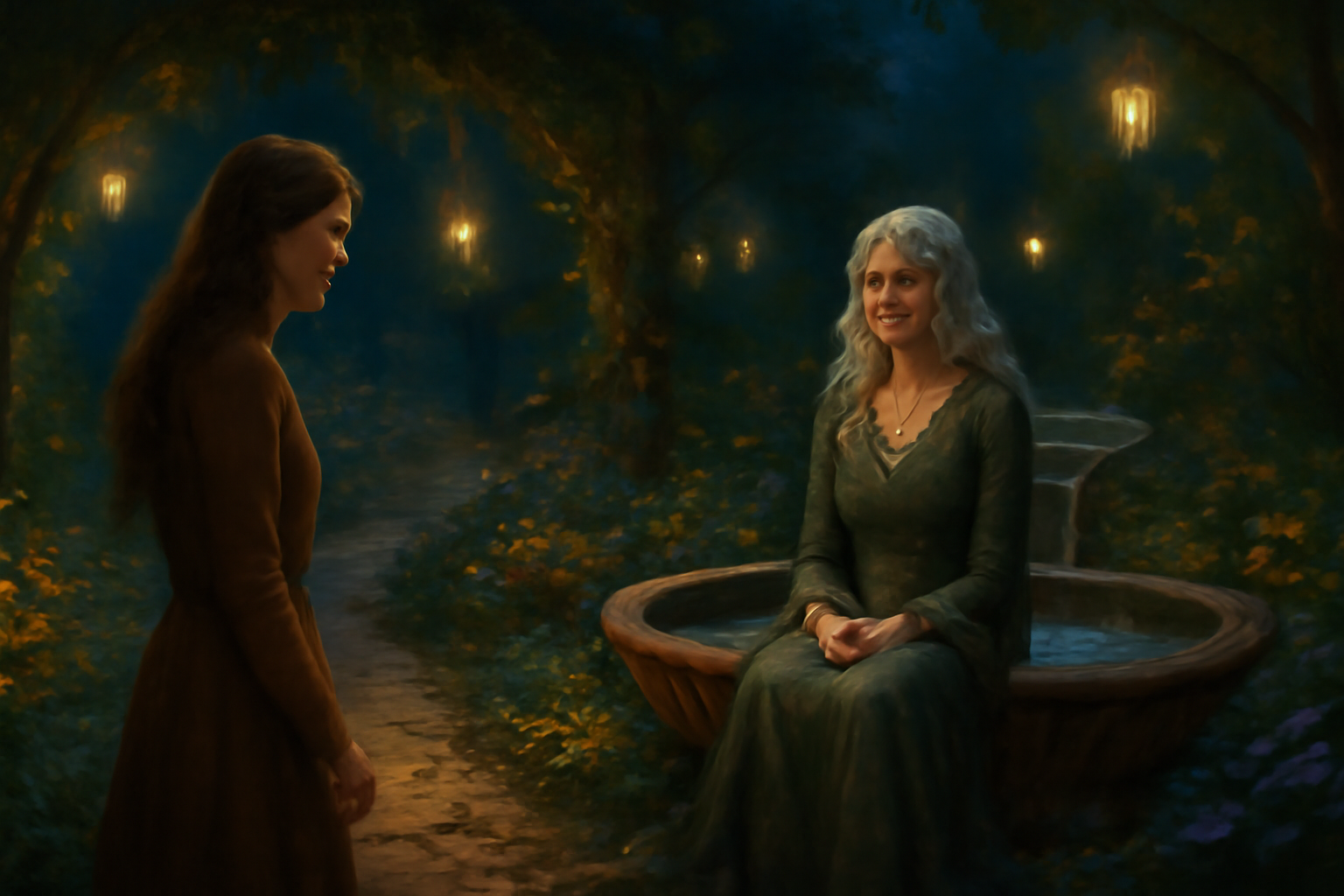
The garden did not appear on any map.
No satellite caught its outline.
No surveyor logged its borders.
No tourist brochure mentioned its existence.
But every so often, when the world became too heavy for someone’s shoulders, a small, folded note would appear in their pocket, or in their shoe, or tucked into the seam of their pillow.
The note always said the same thing:
WHEN YOU’RE READY, FOLLOW THE PATH BEHIND THE LAST LAMPPOST.
BRING ONLY ONE WISH.
AND ONE YOU’RE WILLING TO GIVE BACK.
Most people dismissed it as a prank, an odd coincidence, a scrap of paper tracked in from somewhere else.
Leah didn’t.
Because Leah had nothing left to dismiss anything with.
She found the note on a Tuesday, after the kind of long, gray day that made time feel like chewed gum.
She was standing in the hospital corridor, staring at the closed door of Room 314, where her younger brother, Sam, lay asleep under a web of wires and soft beeping lights.
Eight months since the accident.
Eight months of the word “coma” sitting on her tongue like a stone.
Eight months of specialists and scans and careful explanations that began with “We can’t promise” and ended with “it’s complicated.”
She’d just hung up with their aunt, who wanted updates. With their boss, who wanted timelines. With the bank, who wanted numbers.
No one asked what Leah wanted.
She already knew the answer anyway.
She wanted her brother back.
She wanted to hear him laugh again — that ridiculous, unstoppable laugh that used to fill their tiny kitchen when he burned the pancakes and pretended it was on purpose.
She wanted one morning, just one, where she didn’t wake up wondering whether hope was bravery or cruelty.
Leah pressed her forehead against the cool wall.
“I’d give anything,” she whispered. “If someone—if something—would just tell me what to do.”
When she pulled away, a small folded note fluttered to the floor.
She stared at it.
She hadn’t felt it in her hand before.
Hadn’t seen anyone pass by.
Hadn’t moved.
Her heart thudded as she bent down.
She unfolded the paper.
Simple black ink.
WHEN YOU’RE READY, FOLLOW THE PATH BEHIND THE LAST LAMPPOST.
BRING ONLY ONE WISH.
AND ONE YOU’RE WILLING TO GIVE BACK.
Leah swallowed.
“Okay,” she murmured to nobody. “That’s… weird.”
Back at home that night, she tried to forget it. She microwaved leftover soup. Stared at the TV without seeing it. Scrolled her phone until the words blurred.
But the note sat on the counter, quietly humming at the edges of her awareness.
Follow the path behind the last lamppost.
She knew exactly which lamppost that meant.
At the end of her street, just where the town edge gave way to the old park, a row of lampposts stood like polite sentries. The last one had always flickered inconsistently — too bright some nights, too dim on others.
Sam used to call it “the moody one.”
He’d tap it on their walks home and tell it to “hang in there.”
Leah put the note in her pocket.
Just in case.
The night she went, the sky was clear.
No storm-laced drama.
No mystical fog.
Just a calm, ordinary darkness sprinkled with stars.
The lampposts cast their usual circles of warm light on the pavement as Leah walked down the quiet street. Her breath puffed in soft clouds in the cool air.
She stopped at the last lamppost.
The moody one.
It flickered as she approached, bright-dark-bright, like a nervous breath.
“Hi,” she whispered — because you say hi to things you used to walk past with your brother. “I, um… got an invitation, I think.”
She turned, half-expecting nothing.
But behind the lamppost, where there had always been a chain-link fence and a line of overgrown bushes, there was now…
A path.
Narrow. Twisting. Lined with stones that glowed faintly from within, like trapped fireflies.
Beyond it, where there should’ve been the distant lights of the highway, Leah saw only trees. Tall, unfamiliar trees, breathing in slow, leafy sighs.
The world around her went quiet.
She put a hand on the lamppost to steady herself.
“I’m either extremely stressed,” she muttered, “or this is real.”
The lamppost hummed under her fingers.
She took that as an answer.
Leah stepped onto the glowing stones.
The air shifted.
And the garden woke up.
She felt it before she saw it — a warmth rising from the ground, a whisper curling through the leaves like a question.
Then the trees opened.
And the garden unfolded around her.
It wasn’t neat, or symmetrical, or planned like the city parks she knew. It was wild in the softest way, full of curling paths and arching branches. Flowers bloomed in colors she didn’t have names for. Vines climbed in spirals up wooden trellises, their tendrils tipped with tiny, glowing buds.
The air smelled like rain and mint and fresh-cut apples.
Lanterns hung from branches, flickering with a gentle, living light.
And at the very center of it all, there was a fountain.
Not stone or marble — living wood, grown into a graceful bowl, water spilling over its edges in shimmering streams that evaporated before they hit the ground.
Sitting on the rim of the fountain was a woman.
She looked somewhere between old and young — the kind of face that belonged to someone who had seen centuries and learned to wear them lightly. Her hair fell in silver waves, threaded with tiny dried flowers. Her eyes were green, bright, leaf-sharp.
“Hello, Leah,” the woman said.
Leah’s heart stuttered.
“You… know my name?”
The woman smiled, and the garden seemed to smile with her.
“I know your wish,” she said gently. “Names are easy after that.”
Leah swallowed.
“This is… the garden from the note?”
“Yes.” The woman dipped her fingers into the fountain, and the water shimmered in response. “I am its keeper.”
“You grant wishes,” Leah said.
“Sometimes,” the Keeper replied. “When they come wrapped in the right kind of heart.”
Leah laughed once, bitter and soft.
“My heart is a mess.”
“Messy isn’t wrong,” the Keeper said. “It’s just honest. The garden likes honest things.”
Leah’s throat tightened.
“My wish is simple.”
“Is it?” the Keeper asked, tilting her head. “Say it aloud.”
Leah’s voice cracked.
“I want my brother to wake up.”
The garden went very still.
Even the water paused mid-fall.
The Keeper’s eyes softened.
“Ah,” she whispered. “A wish made of love.”
“I’d give anything,” Leah said. “My savings. My job. My house. My—”
“Careful,” the Keeper said gently. “The garden listens.”
Leah’s hands shook.
“You said to bring one wish,” she whispered. “And one I’m willing to give back. I don’t… I don’t understand what that means.”
The Keeper rose from the fountain. As she stepped forward, small flowers bloomed where her bare feet touched the ground.
“Every wish granted,” she said, “creates a space. A shift in the pattern of things. If the garden gives something, something must be released to keep the balance.”
Leah’s chest constricted.
“You mean a sacrifice.”
“Not of flesh,” the Keeper said quickly. “Not of life. We are not cruel. But attachments. Regrets. Fears. Identities that no longer fit.” She met Leah’s eyes. “We ask: what are you prepared to put down, so that you can hold what you’re asking for?”
Leah looked at her hands.
They felt so full, all at once — of worry, of guilt, of exhaustion.
“What if I don’t know?” she whispered.
“Then walk,” the Keeper said. “The garden has a way of showing you.”
She touched Leah’s shoulder gently.
“Bring your wish with you. Don’t set it down. But be willing to see what else you’re carrying.”
The garden paths shifted as Leah walked.
She didn’t notice at first. She was too busy moving through memories.
Because that’s what the garden showed her.
Not like the past replayed on a screen. More like walking through rooms built from her own life.
She rounded a bend and found herself beside a hospital bed where her mother lay years earlier, pale and small, fingers gripping Leah’s as she whispered, “Promise you’ll look after Sam.”
She turned and stepped into another clearing — her teenage bedroom, where Sam, age nine, clutched a stuffed turtle and asked in a shaky voice if Mom was “really gone, or just… gone for now.”
The garden twisted again, and she was in the office where she’d worked late nights while Sam rehearsed music in their small apartment alone. She saw herself answering emails instead of answering his excited texts. She saw him at the kitchen table, practicing a song he’d written, waiting for her to come home.
“I should have been there more,” she whispered to the leaves. “I should have—”
The garden rustled.
A single petal fell onto her shoulder.
Not scolding.
Comforting.
The Keeper’s voice drifted on the breeze, though Leah didn’t see her.
“Guilt weighs heavy,” it said. “Is it helping him? Or just punishing you?”
Leah’s hands clenched.
The path shifted again.
She stepped into a final memory — the day of Sam’s accident.
The car keys on the counter.
The rain outside.
Sam, shrugging on his jacket, saying, “I’ll be quick, I promise.”
Her, half-distracted, replying, “Yeah, okay,” without looking up.
She’d replayed that moment a thousand times.
She watched herself again.
Only this time, the garden added something new.
She saw the way Sam smiled at her before he left. Soft, fond. No resentment. No reproach.
Just love.
She hadn’t let herself remember that part.
Leah sank to her knees.
Tears spilled, hot and unstoppable.
“I should have stopped him,” she sobbed. “I should have made him stay. It should have been me—”
The trees leaned closer.
Wind shivered through their branches in a sound like a hundred gentle shushes.
The Keeper appeared beside her, folding gracefully to the ground.
“Little gardener of your own heart,” she murmured. “You’ve been tending guilt like a prized flower. Watering it. Feeding it. Carrying it.”
Leah pressed her forehead to her hands.
“I don’t know how to not blame myself.”
The Keeper touched the soil between them.
From it, a small plant sprouted — fast, impossible — a tangled knot of dark vines bearing heavy, stone-like buds.
“This is your guilt,” the Keeper said.
The plant pulsed with a dull, aching light.
“It’s grown strong,” she went on. “Crowding out everything else. But it’s not the only thing that can grow here.”
Leah looked up, cheeks wet.
“I don’t know how to pull it out.”
“You don’t have to,” the Keeper said. “You just have to decide if you’re ready to stop feeding it.”
The plant quivered, as if listening.
Leah stared at it.
She thought of Sam’s smile.
Her mother’s promise.
The weight she’d carried every day since the accident — a belief that she had failed so catastrophically that she no longer deserved anything good.
“What would I give back?” she whispered.
The Keeper tilted her head. “If the garden grants your wish — if it lends its strength to help your brother find his way back to waking — what are you willing to return to the soil in exchange?”
Leah’s voice trembled.
“Can I… give back this belief? That it was all my fault? That I don’t deserve to be happy if he’s not?”
The plant shivered violently.
The Keeper smiled softly.
“Yes,” she said. “You can give back a story that no longer serves you. You can trade it for one where you did the best you could, with the love you had, in a world that is sometimes unbearably random.”
Leah’s shoulders shook.
“Will he… will he wake up?”
The Keeper’s eyes softened.
“I cannot promise outcomes,” she said. “The garden is powerful, but it does not rewrite all of reality. It tilts. It nudges. It offers paths the heart can walk that the body can follow.” She reached out and took Leah’s hands in hers. “But I can promise this: if you make this trade, you will not walk the next part of this story as a punished version of yourself.”
Leah stared at the guilt-plant.
Its stone-buds were cracking now, light bleeding from the seams, as though it, too, wanted to be different.
“I don’t know who I’d be without it,” she whispered.
“Free,” the Keeper said simply.
Leah took a deep, shaking breath.
“I want my brother to have a chance,” she said. “And I want to stop hating myself for surviving.”
She looked at the Keeper.
“I give this back,” she whispered, laying her hands on the dark plant. “I give this story back.”
The ground pulsed.
The plant burst silently into light, dissolving into thousands of tiny glowing seeds that rose into the air like fireflies.
They drifted upward.
Faded.
The earth where it had been was soft, rich, empty.
Ready.
The Keeper touched Leah’s forehead.
Something warm flowed through her — not erasing her grief, but softening its edges, making room for something else.
Hope.
“Your wish has been heard,” the Keeper murmured. “Now go wake up with him.”
Leah blinked.
She was standing behind the last lamppost.
The ordinary streetlights hummed. Distant traffic sighed. The night was just… night.
She clutched at her pockets.
The note was gone.
Her phone buzzed.
A call.
The hospital.
Her heart surged into her throat.
“Hello?”
“Leah?” The nurse’s voice sounded breathless. “Can you come in? It’s your brother. He… well, he moved.”
Leah’s knees went weak.
“Moved?”
“Hand. Fingers. His vitals spiked. The doctor thinks… we might be seeing the first signs of him coming out of it.”
Leah squeezed her eyes shut.
The garden.
The wish.
The trade.
“I’m on my way,” she whispered.
She ran.
It wasn’t an instant miracle.
Sam didn’t spring upright, crack a joke, and pretend nothing had happened.
It was slow.
Fingers twitching.
Eyes fluttering.
Days of confusion and rehabilitation.
Weeks of learning how to be in his body again.
But through it all, Leah was different.
She still loved him fiercely.
Still worried.
Still checked monitors more often than necessary.
But the voice that used to hiss this is your fault had lost its teeth.
When Sam finally looked at her one afternoon and rasped, “Hey, Lee,” she cried so hard he laughed — a small, rusty version of his old laugh.
“Did you… wait here the whole time?” he asked.
She brushed his hair off his forehead.
“Yes,” she said. “But not the way I used to.”
He blinked. “What’s that mean?”
She smiled, thinking of the garden.
“It means,” she said softly, “I’m done punishing myself for loving you.”
He frowned a little. “You… ever did that?”
“Yeah,” she said. “But I gave it back.”
“To who?”
“To where it belonged.”
He considered this, drowsy and thoughtful.
“Well,” he murmured, “that sounds about right.”
He drifted back to sleep.
Leah sat back in her chair, exhausted and impossibly, quietly grateful.
Later, much later, when things were stable and boring and wonderfully normal, she walked past the last lamppost again.
For a moment, just a moment, she smelled mint and rain and apples.
The lamppost flickered.
“Thank you,” she whispered.
The lamppost’s glow warmed.
Just once.
Then it was just a light again.
And Leah walked on, carrying her wish and her brother — and a heart that finally had space for her own life, too.