
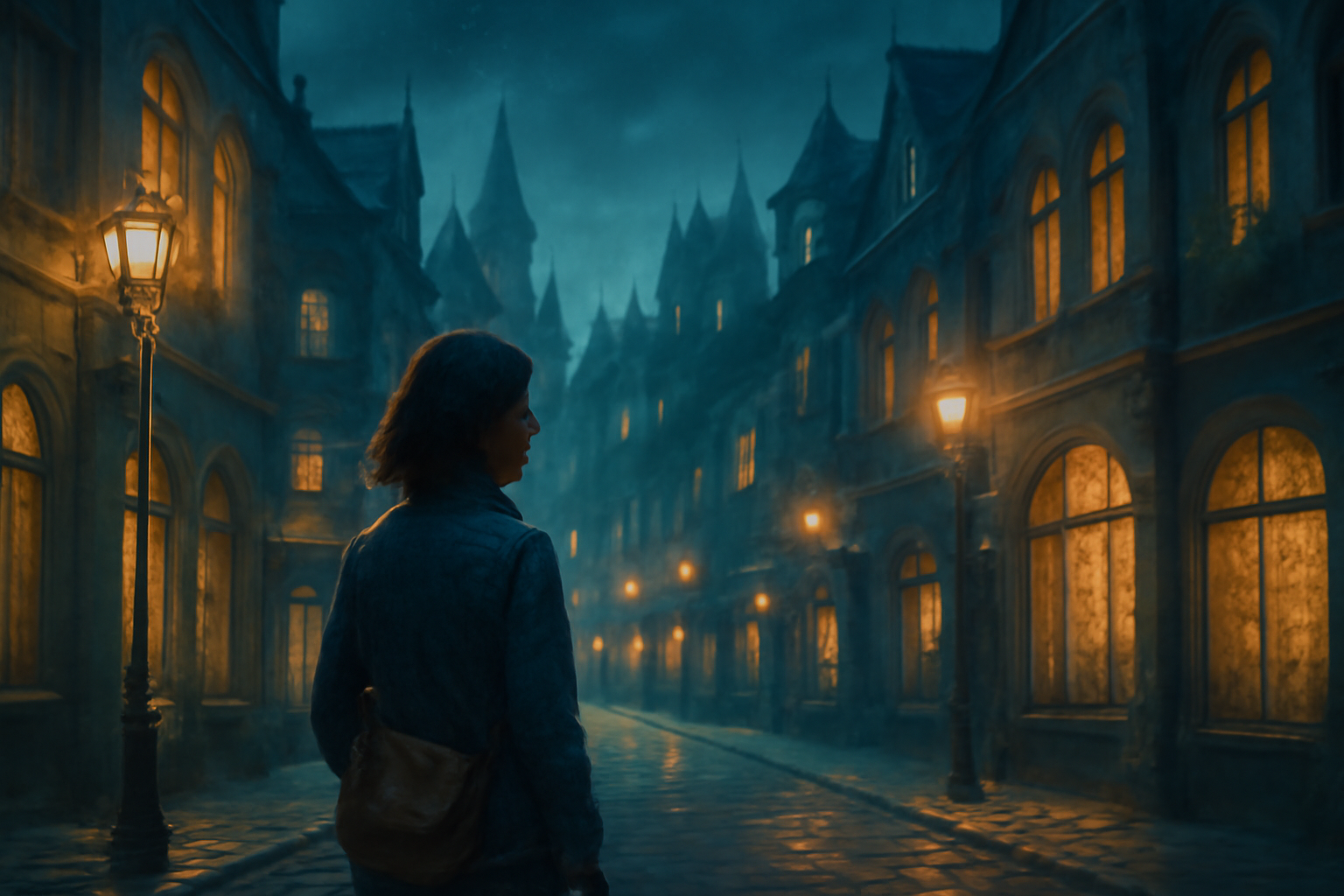
The city was not on any map, and that was the point.
Cities liked to be known, charted, and named. They liked their streets labeled and their boundaries debated. They liked to appear in satellite photos and on tourist blogs and in late-night conversations about “one day, I’m going to move there.”
But this city — the one tucked between moments and stitched through the seams of attention — had only one rule:
It could only exist when no one was looking.
It flickered in when eyes closed.
When people blinked a second too long.
When entire crowds turned their heads at once to watch a passing parade, a meteor, a kiss.
It was both everywhere and nowhere.
It was called Veilworth by the few who ever remembered it.
And it was waiting for someone.
Mara Quinn had always felt like she was living just to the side of her own life.
In group photos, she was the one on the edge of the frame, half-cropped out. In conversations, she was the listener, the nodder, the one people trusted with secrets but rarely with invitations. She was excellent at being invisible.
Some days, it hurt.
Some days, it was a relief.
Lately, it mostly felt lonely.
At twenty-eight, Mara worked as an overnight security monitor in a small building downtown. Her job was, essentially, to watch screens — a grid of CCTV feeds showing empty lobbies, parking lots, sleepy sidewalks. Most nights were uneventful.
Which gave her a lot of time to think.
And overthink.
And feel very, very small.
She left work just before dawn, when the sky was soft blue-gray and the world felt half-finished. It was her favorite time — the city quiet, the day not yet demanding anything.
Except, on this particular morning, the city felt… wrong.
Not dramatically.
Just slightly.
Certain streetlights were taller than they had been.
A building that usually had three windows on its front now had four.
The alley between the bakery and the pharmacy seemed narrower.
Mara frowned as she walked her usual route home.
“Did they renovate overnight?” she muttered.
The pigeons didn’t answer.
She turned onto Wren Street, where she always cut through to shave five minutes off her walk. It was usually just a normal little side street: dumpsters, back doors, a stray cat with one ear folded.
Today, it was empty.
Empty in a way that felt… deliberate.
No trash bins.
No parked cars.
No cat.
Just a long, quiet stretch of wet pavement and fog.
Mara stopped.
The hair on her arms prickled.
“Okay,” she whispered. “This is weird.”
Then something flickered at the edge of her vision — a brief glimmer, like a reflection in glass.
She turned her head—
And saw nothing.
She looked forward again.
There, for the tiniest fraction of a second, something shone.
A streetlamp that hadn’t been there.
The curve of an unfamiliar balcony.
A sign in a language she didn’t know.
All in the space between one blink and the next.
Mara held her breath.
Then did something she didn’t usually do.
She closed her eyes on purpose.
And kept walking.
The air changed.
Not in temperature, exactly — more in texture. Sound shifted, too, like she’d stepped from a hallway into a concert hall mid-song.
Mara walked three careful steps, eyes still shut.
Her heartbeat fluttered.
If I hit a wall, she thought, I’m going to feel really stupid.
She opened her eyes.
And the world had changed.
The alley was gone.
In its place, a wide, cobbled street stretched under soft lantern light. Buildings rose three, four, five stories high — a riot of styles and colors somehow fitting together like pieces of an elaborate puzzle.
Balconies overflowed with flowering vines glowing faintly in shades of blue and gold. Shop windows displayed impossible items: jars of captured laughter, clocks with hands that moved backward but still told the right time, tiny glass orbs holding storms that never escaped.
People walked the street — not many, but enough — dressed in clothes that looked half-modern, half-from-somewhere-else. No one seemed hurried. No one bumped shoulders. The air buzzed with a low, contented murmur, like a gentle street market at the edge of a dream.
A small sign hung from a lantern post beside her:
WELCOME TO VEILWORTH
(Please Don’t Stare Too Long —
We Disappear When Seen Too Hard)
Mara’s knees nearly gave out.
“Oh,” she whispered. “I’m either finally asleep, or…”
“Or you’re paying attention differently,” a voice said behind her.
She turned.
A man stood there, maybe in his thirties, with dark curls, a soft sweater, and the kind of smile that made people relax without knowing why. He held a paper cup of something steaming.
“You’re new,” he said.
Mara stared like a deer caught in very gentle, very patient headlights.
“I… uh. Yes? I think? I was just walking home and then…”
“You looked away,” he said. “On purpose. That helps.”
She blinked. “Helps what?”
“Helps us exist,” he said cheerfully, gesturing around. “Veilworth appears in the cracks of attention. One eye closed. Averted gazes. Moments when people aren’t trying to pin the world down. You slipped through one.”
Mara clutched her bag tighter.
“Is this… some kind of hallucination?” she asked. “Should I be worried?”
He considered.
“Well, if it is, we’re collectively very committed to the aesthetic,” he said. “But no. You’re not broken, Mara.”
She flinched.
“I didn’t tell you my name.”
He took a sip from his cup.
“You didn’t have to. Veilworth knows the people who need it.” He offered his free hand. “I’m Silas.”
She hesitated.
Then shook his hand.
It felt solid. Warm. Real.
“Why… would I need it?” she asked, words escaping before she could swallow them back.
Silas tilted his head as they began to walk down the lantern-lit street.
“Veilworth is a city for the overlooked,” he said. “For the almost-seen. For people who stand at the edge of their own lives and wonder when it’ll be their turn to be… central.”
Mara swallowed.
“I didn’t realize I was that obvious.”
“You’re not,” he said kindly. “That’s the problem, isn’t it?”
They passed a bakery that smelled like cinnamon and citrus, a bookstore whose shelves rearranged themselves when you glanced away, and a little park where the trees had leaves shaped like tiny hands, waving idly at anyone who looked their way.
Mara’s shoulders slowly relaxed.
“This place is impossible,” she murmured.
“Improbable,” Silas corrected. “Not the same thing.”
“Where… is it?”
He shrugged. “Between. Under. Around. It lives in the instants when nobody is trying to define everything. That’s why we vanish when stared at too hard.”
“Who’s ‘we’?” she asked softly.
Silas smiled.
“The city and the people who find it.”
They stopped at a small café with a sign that read:
THE MOMENT BETWEEN SIP & SWALLOW
Silas held the door.
Inside, the café hummed with a soft, timeless calm. People sat at mismatched tables, talking in gentle tones, writing, drawing, staring out windows that looked onto streets Mara didn’t recognize and also streets she did — her own city, but slightly… blurred.
Behind the counter, a barista with bright blue hair and silver eyes nodded at Silas.
“New arrival?”
“Caught us on a blink,” he said.
“Good catch,” the barista replied, then looked at Mara. “Welcome. First drink’s always on us. Helps you acclimate.”
Mara approached the counter slowly.
“I… don’t know what to order,” she admitted.
The barista tapped her chin thoughtfully.
“Are you more ‘regret about the past’ or ‘terror about the future’ tonight?” she asked.
Mara stared.
“I… sorry, what?”
“Or,” the barista added gently, “are you just… tired of feeling like a background extra in every scene?”
Mara’s eyes burned suddenly.
“That one,” she whispered.
“Thought so.” The barista smiled and began to brew something that smelled like chamomile and woodsmoke and the first day of spring. “We call this one a Centering Brew. You drink it slowly. It helps you hear yourself under everybody else’s expectations.”
Mara took the warm mug in both hands.
“Thank you.”
She and Silas found a small table by the window.
Outside, the city moved in small, graceful ways — a cat slipping under a bench, a lamplighter coaxing flames into lanterns with a whispered word, children chalking constellations onto the street.
“So,” Silas said softly, when she’d had her first sip. “Want to tell me why Veilworth reached out?”
Mara watched the swirl of steam.
“I don’t know,” she said. “I just… I feel like I’m always watching my life instead of living it. Like everybody else got the script, and I’m just improvising lines nobody hears.”
Silas nodded.
“That’s a common entry requirement.”
She laughed weakly.
“I thought I was okay with being quiet. With being the one who supports from the side. But lately it just feels like… I could disappear from my own story and nothing would change.”
Silas leaned back.
“Mara, what’s something you want that you’ve never said out loud?”
Her grip tightened on the mug.
“I want…” She hesitated — afraid the word would sound ridiculous outside her head. “I want to be chosen. Not because I’m useful. Not because I’m there. Just… because I’m me.”
The café seemed to hush around them.
Silas’s eyes warmed.
“I’m glad you said it,” he said. “Veilworth thrives on true sentences.”
“Is that… why I can see this place?” she asked.
“In part,” he said. “People who are always being looked at rarely find Veilworth. They’re too busy performing. But those who are never truly seen? The city has a soft spot for them.”
She thought of her small apartment. Her quiet job. The way her absence at gatherings was often met with, “Oh, were you coming?”
“Can I stay?” she asked, voice small. “Here. Where things… notice me.”
Silas looked out the window, watching a lantern flare brighter as a child laughed beneath it.
“Veilworth isn’t an escape hatch,” he said gently. “It’s a mirror turned kindly. It lets you practice being visible, feeling central, in a place that won’t punish you for needing that.”
He looked back at her.
“But it only exists when nobody’s looking. You can’t live your whole life in the corners and expect the world to rearrange itself around what you never ask for.”
She dropped her gaze.
“I don’t know how to ask,” she whispered.
“That,” he said, lifting his cup in a small toast, “is what we’re here for.”
They walked more after the tea.
Silas showed her the Gallery of Unlived Days — an alleyway where paintings appeared in the air, each one showing something you might have done if you’d believed you were allowed to.
Mara saw herself teaching a class, hands moving animatedly. Saw herself on stage at a small poetry reading, voice trembling but present. Saw herself saying yes to a road trip instead of making excuses.
“It’s not too late for any of these,” Silas said quietly. “Veilworth doesn’t deal in regret. It deals in reminders.”
They climbed a set of stairs that hadn’t been there a moment ago and reached a rooftop garden where lanterns floated like lazy fireflies. People sat there alone or in pairs, eyes closed, hands pressed over their own hearts like they were listening to something within.
“What’s this place?” she asked.
“The Listening Deck,” Silas replied. “Sometimes you need a place where the only voice is your own.”
“Sounds loud,” she said with a shaky smile.
“Messy,” he agreed. “But honest.”
He turned to her.
“When you leave,” he said, “things won’t magically be fixed. You’ll still have the same job, the same friends, the same city that doesn’t quite know what to do with you. The only difference… will be you.”
She swallowed.
“How?”
“You’ll know what you want,” he said. “And that you’re allowed to want it. Even if you say it quietly. Even if it’s only to yourself at first.”
She looked around.
“Will I remember Veilworth?”
“Most people remember it like a very sharp dream,” he said. “But you’ll remember how it felt. How you felt here.”
He reached into his pocket and handed her something small.
A coin.
On one side, a tiny, detailed image of the city skyline. On the other, a single word:
LOOK.
“This is for when you catch yourself slipping back into the margins,” he said. “Flip it. If it lands city-side up, you close your eyes and ask yourself what you want in that moment — not ten years from now. If it lands on ‘LOOK,’ you ask yourself where you’re refusing to look at your own needs.”
Mara turned the coin over in her fingers.
“What happens if it lands on its edge?” she asked, trying to joke.
“Then,” Silas said, “you’re officially overthinking it and should probably drink some water.”
She laughed, unexpectedly bright.
The sky above Veilworth shifted color — a signal.
“Time’s almost up,” he said gently.
Her chest ached in a new, hopeful way.
“Will I see you again?” she asked.
“Likely,” he said. “Veilworth tends to reappear when you forget yourself too hard. But my biggest hope?”
He held her gaze.
“Is that you won’t need us as much.”
Leaving was as simple as closing her eyes and stepping forward.
When she opened them, she was back on Wren Street.
The alley was normal again.
Dumpsters.
Brick walls.
The one-eared cat, glaring at her from atop a recycling bin.
Her phone buzzed.
A message from a coworker:
You off shift? We’re getting coffee if you want to join. No pressure.
Normally, she’d type something like Maybe next time and put the phone away.
Instead, she flipped the coin in her hand.
It landed on the side with the skyline.
She closed her eyes.
“What do I want?” she whispered.
The answer rose, quiet but clear:
Connection.
“Yeah,” she breathed. “Okay.”
She typed:
I’d love to. Be there in 10.
As she walked toward the café, the city seemed ever so slightly different. Not because the buildings had changed, or the streets had rearranged.
Because she walked like someone who might, one day, stand in the middle of her own life instead of its edges.
She passed a window and caught her reflection.
For once, she didn’t look away.
And far, far in a place just to the side of seeing, Veilworth glowed a little brighter.
Because someone it had sheltered was stepping back into the world — not to vanish, but to be seen.The City That Only Exists When No One Is Looking