
That was the only reason she’d flown to Naples in the first place: a dusty side-panel on “Uncatalogued Latin Papyri in Private Collections” that everyone else ignored in favor of the shiny AI-in-the-archive talk down the hall. Emilia sat in the second row, notebook open, half-listening, half-judging.
Most “uncatalogued treasures” turned out to be shopping lists or tax records. Valuable to historians, yes. World-changing? Not so much.
So when the nervous Italian curator on stage cleared his throat and said, “This next scroll is… unusual,” she almost rolled her eyes.
Then he projected the image.
The papyrus was old, yes—but not crumbling. Its fibers were dense, the ink still a rich, almost oily black. The text ran in tight columns, the Latin script elegant and startlingly consistent, as though written in a single sitting by a hand that never tired.
What made Emilia sit up, though, weren’t the words.
It was the diagram drawn in red at the bottom of the scroll: a circle with four smaller circles at its cardinal points, all joined by intersecting lines. Around it coiled a short line of script in a smaller hand.
The hairs on her arms lifted.
That script wasn’t standard Latin.
It was something older. Stranger.
“—we have not yet translated the marginal note,” the curator was saying. “The main text appears to be a philosophical riddle about time and the nature of memory, possibly late Augustan or early Imperial—”
Emilia raised her hand before she could stop herself. “May I see a higher-resolution image of the marginalia?”
The curator blinked. “Ah, yes, of course. After the session.”
She didn’t wait.
Three hours later, she was standing in the bowels of the Museo di San Paolo, where the climate control hummed louder than any conversation and everything smelled faintly of dust and disinfectant.
The scroll lay on a glass cradle, lit from above by a precise, unforgiving spotlight. Up close, it was even more unnerving.
The main text was indeed philosophical—dense, convoluted ruminations on time flowing like a river that doubled back on itself. Not unlike some late Stoic writings. But the marginal note in red ink twisted around the diagram like a serpent.
Emilia bent closer.
The script looked like Latin’s older cousin: familiar letters hooked into unfamiliar shapes, abbreviations that suggested someone in a hurry—or someone hiding something.
“Well?” the curator asked, hovering.
“It’s a riddle,” she murmured. “But not the kind you think.”
Her fingers itched for a pencil. She copied the red script into her notebook, sounding out the syllables under her breath.
“Tempus… clauditur… per circulos… non in mensura, sed in locus…” She frowned. “Time is closed by circles, not in measurement, but in place.”
Her pulse quickened.
“… Vertex hic est… Aperi verbo recto… et iter patebit.”
“‘The pivot is here,’” she translated. “‘Open with the correct word, and the path will lie open.’”
“That sounds… ominous,” the curator said weakly.
“Or theatrical,” Emilia replied. But her voice didn’t sound convinced, even to herself.
She studied the diagram.
A central circle. Four around it. Lines crossing like a compass.
A place. A pivot.
“May I?” she asked quietly, nodding toward the glass.
“Touch it?” The curator looked horrified. “No, no, the papyrus is very fragile, we—”
“I meant,” Emilia amended, “may I read it aloud? Completely. With the marginal note. Exactly as written.”
He hesitated. “As long as you don’t—”
“I won’t sneeze on it,” she said.
He gave a nervous little laugh and stepped back.
Emilia drew a breath, feeling ridiculous, and began to read. Her Latin was clear, her tongue practiced; she gave the text the rhythm its author seemed to intend.
The main body flowed like a lecture, describing time as a great wheel turning through human lives, events repeating in hidden patterns. The diagram was referenced halfway through—“where the wheel touches the earth”—but never fully explained.
Then she reached the marginal note.
Her voice dropped, almost without her intending it. The tiny red letters seemed to glow in the glass.
“Tempus clauditur per circulos…” she read, following the curl of ink. “…Vertex hic est. Aperi verbo recto… et iter patebit.”
She spoke the final word—patebit—with crisp precision.
The lights flickered.
Emilia stopped.
The curator blinked up at the ceiling. “It’s nothing. Old building. Power—”
The overhead spotlight snapped off.
For a moment, they stood in semi-darkness, lit only by the soft green glow of climate-control indicators.
Then the diagram on the papyrus began to glow.
Not metaphorically. Literally.
Soft red light bled from the ink, filling the etched circles, brightening with each passing second. Lines of light connected each smaller ring to the central one, fluttering like nervous pulse.
Emilia’s heart hammered.
“Is… that… some kind of chemical—?” the curator stammered.
“No,” Emilia whispered. “It’s not.”
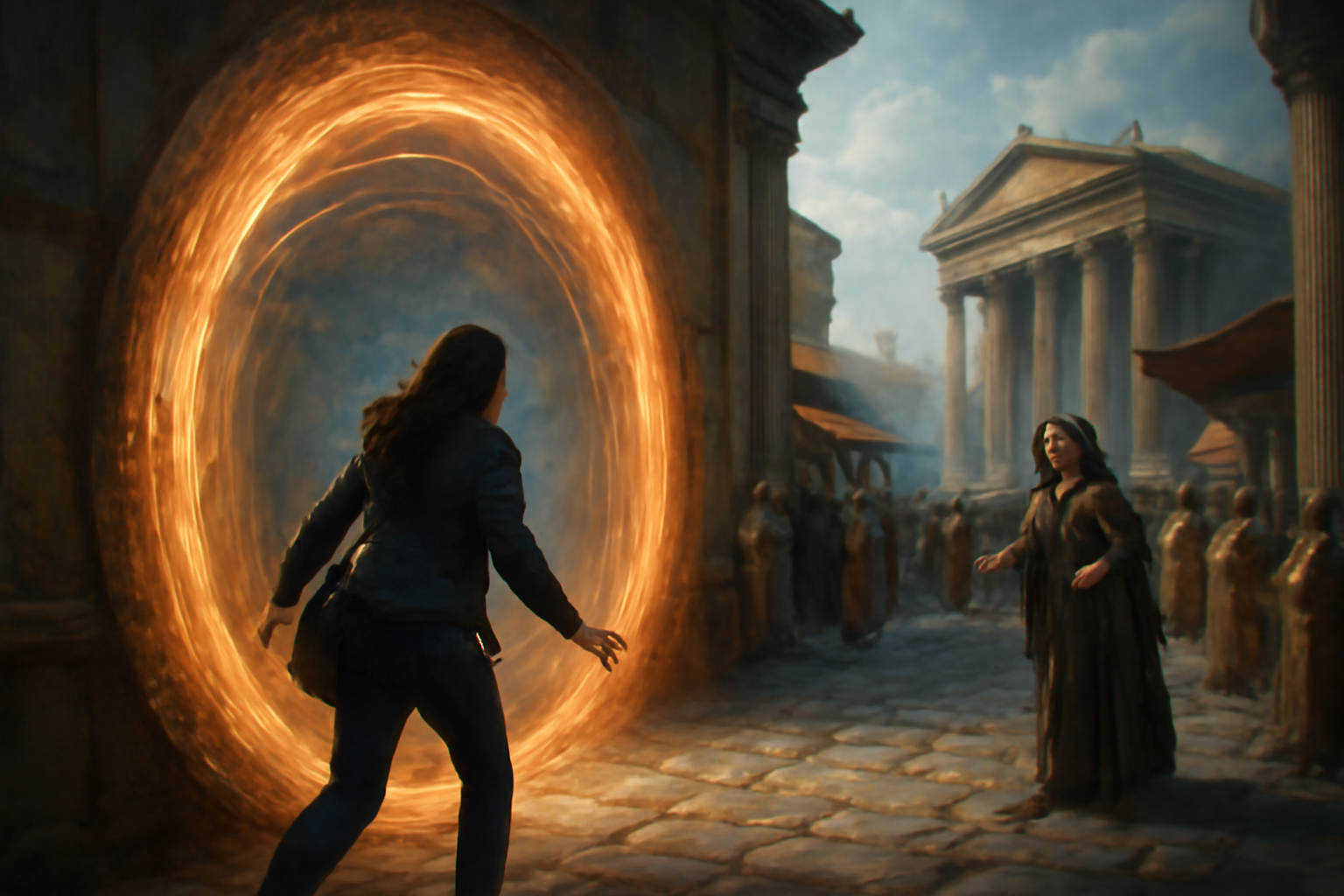
The air above the scroll wavered, as though heat were rising from it, though the temperature in the room dropped sharply enough that her breath fogged. The light from the papyrus coiled upward, forming a sphere of shimmering red in mid-air.
Inside the sphere, shapes flickered: columns, arches, the vague outline of a wide road.
The curator took a stumbling step back. “This is a trick. A projection. Someone—”
“Who?” Emilia asked without looking at him. “You saw the lights go out. There’s no power to the projectors.”
The sphere expanded, its surface thinning until it became a membrane, translucent and fluid.
On the other side, the shapes clarified.
A crowded street under a gray sky. People in tunics and cloaks. Vendors shouting. The smell of smoke and something else—wet stone, crushed herbs, human sweat—flooded into the archive.
Emilia gagged.
This was not a hologram.
A cart rattled past on the other side, drawn by a pair of horses whose harness bells jingled in a rhythm that felt dizzyingly real. A man shouted in Latin, his accent old but intelligible.
“Move aside!”
The cart rattled dangerously close to the inner edge of the sphere. As one of the wheels crossed the boundary, the entire construct pulsed.
The front half of the cart—horse, harness, and driver—vanished from the sphere’s internal image.
A chorus of shocked screams echoed from within.
Something heavy crashed in the archive behind Emilia.
She turned.
The front half of the cart—and the horse, and the driver—had materialized on the polished museum floor.
The horse shrieked, eyes rolling, hooves scrabbling on the slick surface. The cart slammed into a row of shelving, sending ancient crates and catalogs flying.
The curator screamed. “Security! Security!”
Emilia barely heard him. Her gaze was locked on the sphere.
The portal—it had to be a portal—shuddered like a disturbed pond. The scene beyond it tilted, swaying.
A woman on the other side stared straight at Emilia. She wore a dark stola, hair pinned with plain bronze, eyes sharp and assessing.
“You,” she shouted over the din, pointing directly at Emilia. “You spoke the word.”
Emilia’s mouth went dry. “You can hear me?”
The woman’s expression shifted—fear, calculation, something harder. “Of course I can hear you. You’re standing in the doorway of the Templum Temporum and you’ve just severed a trade wagon and its owner in half between worlds. Do you have any idea what you’ve done?”
“Not… entirely,” Emilia admitted.
The woman cast a quick look over her shoulder, then back. The street behind her was in chaos—people shouting, horses rearing, soldiers pushing through the crowd.
“Then listen carefully,” she said. “You have opened a path between your time and mine. It will not stay stable. Either you step through and close it from this side—my side—or you let it collapse and hope your world survives what leaks through.”
Something huge moved in the hazy distance behind her—like a shadow cast by no visible object, sliding along the line of buildings.
Emilia shivered.
“How do I know stepping through isn’t worse?” she asked.
“You don’t,” the woman said bluntly. “But I do know this: the priests who built this gate believed time was a beast that circled the same roads again and again. They thought if they could stand at the crossroads long enough, they could change its path.”
“And did they?” Emilia asked.
The woman’s smile was brittle. “We’re having this conversation, aren’t we?”
The shard of cart on the museum floor groaned as the horse struggled to its knees. The curator was babbling into his phone. Alarm sirens began to wail somewhere distant in the building.
Emilia’s rational mind screamed at her to back away. To call the police. To pretend this was a gas leak hallucination.
But she hadn’t dedicated her life to dead languages because she liked safe stories.
“What’s your name?” she asked.
“Claudia Marcellina,” the woman replied. “Archivist of the Temple of Time. And if you’re coming, move.”
Behind her, through the wavering portal, a group of men in bronze helmets were shoving their way forward, shields braced, expressions grim. Time priests, Emilia thought wildly. Or soldiers. Or both.
The sphere flickered.
The edges of the doorway began to fray.
“Now,” Claudia snarled.
Emilia took a breath that tasted like old paper and burning incense—and jumped.
The world turned inside out.
For a heartbeat, she hung in a place that wasn’t place, buffeted by currents of sensation—voices in languages she didn’t know, flashes of landscapes she’d never seen, the iron tang of blood, the salty slap of ocean spray, hot desert wind.
Then she crashed onto rough stone, knocking the air from her lungs.
Hands grabbed her, dragging her upright.
The street smells hit her full force. The noise of the crowd pressed in from every side—Latin shouted in sharp, streetwise accents, the clatter of sandals and hooves, the crack of a whip.
Emilia blinked.
Rome stretched around her in every direction. Not the ruins she’d toured as a tourist, but the living city: walls uncrumbled, temples pristine, paint still bright.
“Shut it!” Claudia shouted.
Several robed men around the glowing doorway began chanting, hands tracing shapes in the air. The sphere shrank, its surface tightening, until it snapped back into a fist-sized point of red light and vanished.
Behind it, where the gateway had stood, there was only the stone wall of the temple.
The air rushed inward, filling the void.
Emilia swayed.
Claudia caught her arm. “You’re paler than a ghost. Breathe.”
Emilia inhaled shakily. “I just left my entire world behind.”
“Temporarily, if we’re lucky,” Claudia said. “Permanently, if we’re not. Either way, we now share a problem.”
“What problem?”
Claudia tilted her head toward the far end of the forum.
The shadow Emilia had noticed earlier was closer now—a slightly darker blur against the bright afternoon, sliding along the rooftops like a stain. Wherever it moved, people shivered, stepping aside without quite knowing why.
“The beast,” Claudia said softly. “The one your riddle woke up again. The one my priests thought they could tame.”
Emilia’s throat tightened. “Time?”
Claudia’s eyes glittered. “Something that eats time. If that gate collapses incorrectly, it won’t just take a few seconds. It will chew its way along the road between your age and mine.”
She released Emilia’s arm and straightened, squaring her shoulders against the oncoming darkness.
“So, Dr. Emilia Hart of the future,” she said, voice suddenly formal. “Let’s find a way to fix what you just opened.”
Emilia looked back at the temple wall, where no sign of the portal remained, then at the city around her—the living, breathing Rome she had studied for half her life.
For better or worse, she was in.
“Right,” she said, swallowing. “Where do we start?”
Claudia’s smile was sharp and fierce.
“By stealing the scroll,” she said, “before history does what it always does and tries to erase us both.”