
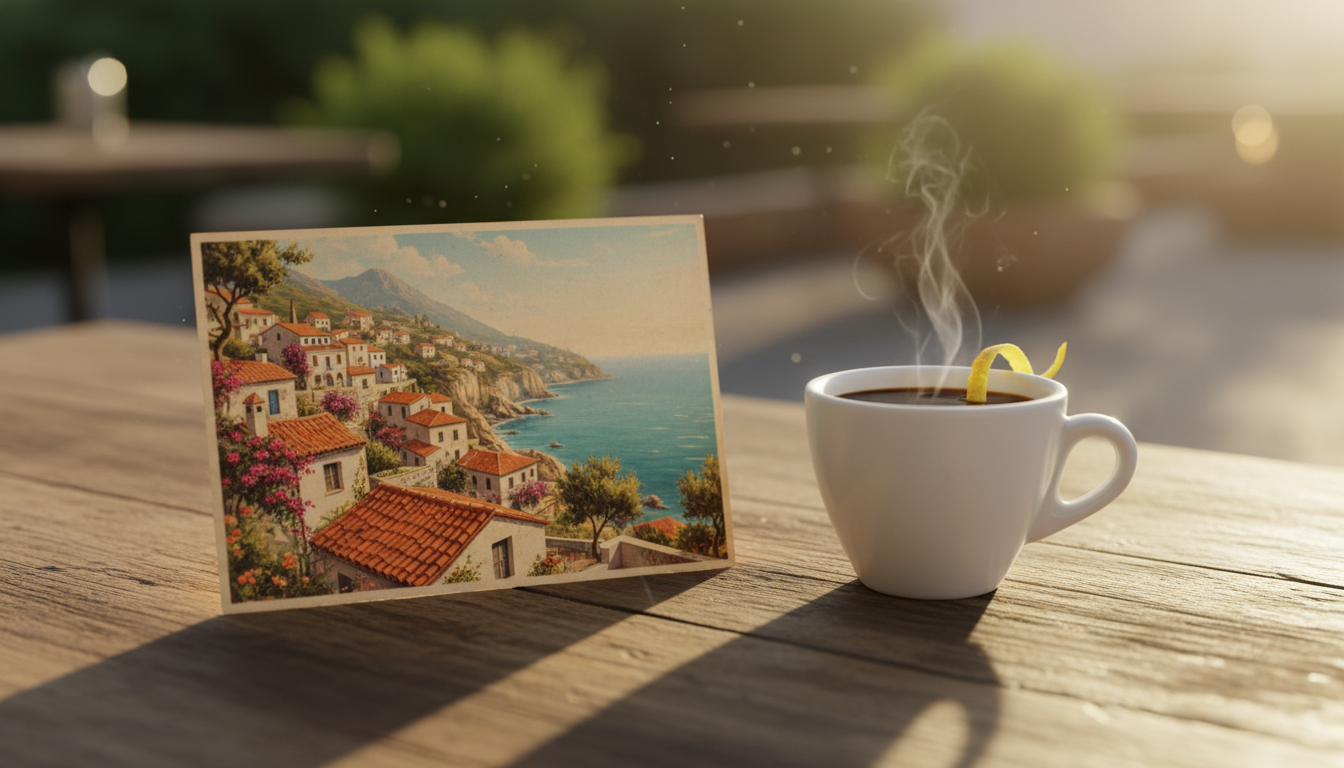
The arrival was always the same, timed with the precision of the seasons, yet wrapped in the unpredictability of the wind. It happened every November, usually on a Tuesday when the sky was the color of bruised slate and the city felt particularly heavy. Clara would unlock her mailbox in the lobby of her apartment building, sifting through utility bills and grocery fliers, until her fingers brushed against the thick, textured cardstock that felt unlike anything else.
It was happening again. The twelfth year in a row.
Clara didn’t look at the picture immediately. She held it by the edges, treating it with the reverence one might offer a holy relic or a very old photograph. She took the elevator up to the fourth floor, the hum of the machinery filling the silence, her heart beating a steady, curious rhythm against her ribs. Only when she was safe inside her small, tidy kitchen, with the kettle whistling its rising note, did she flip the card over.
The image was always of the same town, though the angle changed. This year, it was a view from a high balcony looking down over terracotta rooftops toward a sea so blue it looked like spilled ink. The light in the photo was golden, the kind of “magic hour” glow that photographers chase for a lifetime.
She turned it over. There was no return address. Just a stamp featuring a bird she didn’t recognize—something with crested feathers and a long, elegant tail—and the postmark: Isla de Sombra.
The message, scrawled in a looping, hurried script with fountain pen ink that shimmered slightly violet, was brief.
“The jasmine is blooming early this year. The scent catches in the curtains. You would like the coffee at the corner shop; they serve it with a twist of lemon peel.”
There was never a signature. Just the observation, intimate and specific, as if the writer were sitting right across from her, continuing a conversation that had been paused only a moment before.
Clara had never been to Isla de Sombra. For the first three years, she had searched for it on maps. She had scoured the internet, finding places with similar names but none that matched the architecture or the geography shown in the glossy images. It was a ghost town, or perhaps a place too small to be noticed by the satellites that mapped the world. Eventually, she stopped searching and started collecting. She kept them in a lacquered wooden box that had once belonged to her grandmother, a treasure chest of memories from a life she wasn’t living.
Clara was a woman of safe choices. She worked in archives, preserving other people’s histories. She wore sensible shoes and ate oatmeal for breakfast. The postcards were the only wild thing she owned.
But this year felt different. The message about the coffee—it felt like a direct address. Clara drank her espresso with lemon peel, a quirky habit she had picked up from an old novel and never dropped. How could the sender know?
She looked at the image again. In the bottom corner, barely visible in the shadow of an awning, was a street sign: Calle del Destino. And below it, a small bistro sign: El Reloj.
A sudden, terrifying thought gripped her. What if the sender stopped? What if the person holding the pen grew too old, or the ink ran dry? The thought of a November without the card made the gray afternoon feel suddenly suffocating.
Clara made a decision before she could talk herself out of it. She took a week of leave. She packed a bag not with sensible work clothes, but with linen trousers and a sun hat she had bought on impulse years ago and never worn. She booked a flight to the nearest major airport she could guess based on the vegetation and architecture—somewhere in the Mediterranean—and trusted that the rest would reveal itself.
The Search for the Shadow Island
The journey was not straightforward. It involved a plane, a train that rattled along a coastline that smelled of pine needles, and finally, a ferry that seemed to run on no schedule other than the captain’s whim. When Clara asked the locals about Isla de Sombra, they shrugged. But when she showed the ferryman the postcard, his eyes crinkled.
“Ah,” he said, pointing a calloused finger toward a haze on the horizon. “Porto Vento. But the old locals, they call it the Shadow Island because of how the clouds cling to the peak in the morning.”
As the ferry approached, the gray veil of her anxiety began to lift. The water turned that impossible ink-blue. The terracotta roofs rose from the cliffs like a natural formation. It was the place. The air hit her face, warm and carrying the scent of salt and… yes, jasmine.
Clara walked through the streets in a daze. It was the strangest sensation of déjà vu. She knew that if she turned left at the fountain, she would find a staircase with blue tiles. She turned, and there they were. She knew the church bell would ring slightly off-key. It clanged, flat and charming, just as she reached the top.
She found El Reloj easily. It was a small cafe with wrought-iron tables and a striped awning. She sat down, her heart hammering. A waiter approached, a young man with a kind face.
“Espresso,” she whispered. “With a twist of lemon peel, please.”
The waiter paused, his pen hovering over his pad. He looked at her, really looked at her, for a long moment. “We haven’t served it that way in a long time,” he said softly. “Not since my grandfather passed. But he always said someone might come asking for it.”
Clara felt a chill that had nothing to do with the breeze. “Your grandfather?”
“Yes. He was a writer. A romantic. He used to sit at this very table every morning for forty years. He wrote letters to everyone he lost, and everyone he hoped to meet.”
The waiter went inside and returned not with coffee, but with a shoebox. It was identical to the one Clara had at home.
“He left this,” the waiter said, placing it on the table. “He said, ‘When the lady comes who orders the coffee with lemon, give her the rest of the story.’”
Clara opened the box. Inside were stacks of postcards, pre-addressed to her. Hundreds of them. Enough for a lifetime of Novembers. But on top was a folded letter.
Her hands trembled as she unfolded the paper. The handwriting was the same looped violet script.
My Dearest Clara,
You do not know me, but I knew your mother. We met in this square before you were born, before life pulled us in different directions—her to the safety of the city, me to the quiet of the island. We made a pact that we would never let the magic fade from our lives. She promised to send me books; I promised to send descriptions of the sun.
When she passed, I couldn’t stop writing. I wrote to you instead, hoping that one day, the words would be enough to pull you out of the gray and into the light. I wanted you to know that there is a place in the world where you fit, even if you have never been there.
If you are reading this, I am gone, but you are here. And that is all I ever wanted. The view is yours now.
Clara looked up. The sun was setting, casting the golden