
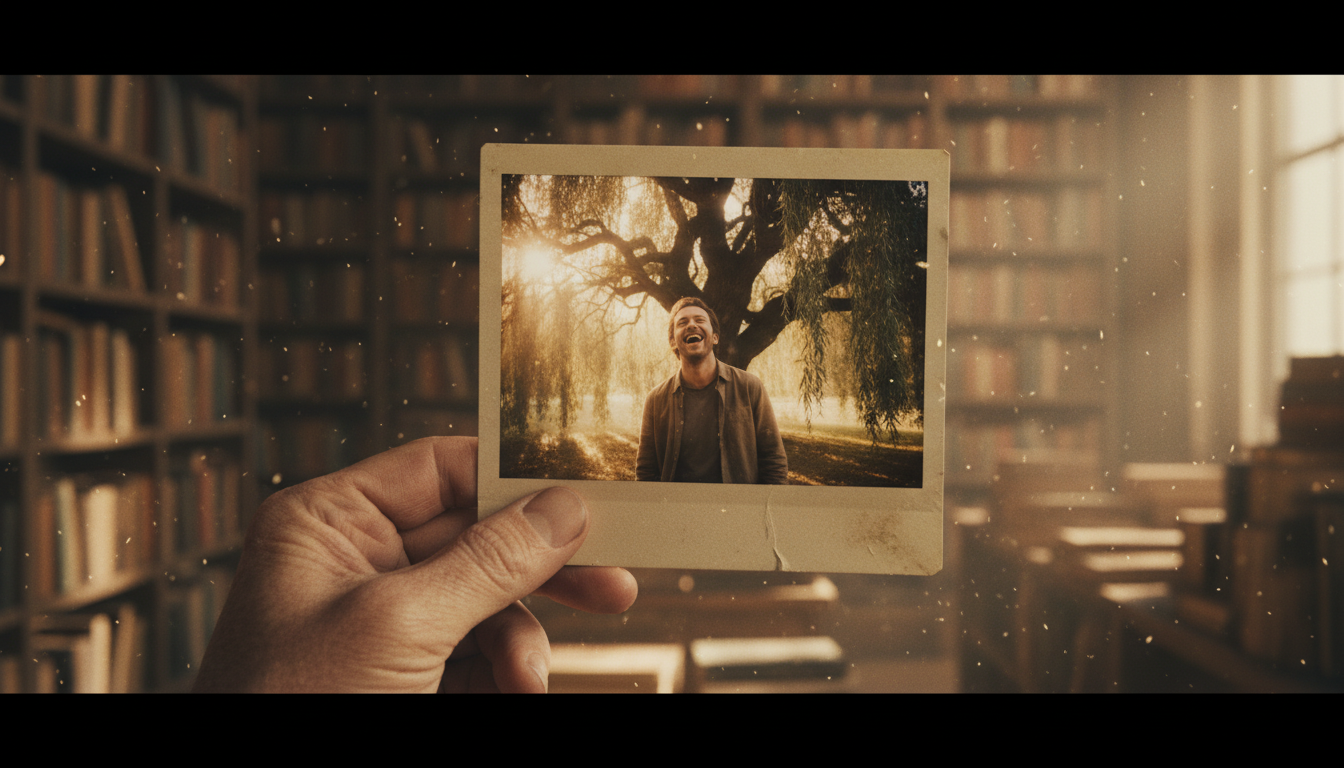
The photograph fell out of a second-hand copy of Great Expectations, fluttering to the floor of the bookstore like a dry autumn leaf. Julian, a man who lived his life by the reliable ticking of a wristwatch and the predictable schedules of trains, bent down to retrieve it. He expected it to be a bookmark left by a previous owner—a receipt, a ticket stub, perhaps a postcard from a forgotten seaside town.
Instead, he found himself staring at his own face.
It was a Polaroid, the colors slightly washed out in that nostalgic, creamy way, bordered by a thick white frame. In the image, Julian was sitting on a wrought-iron bench beneath the cascading branches of a willow tree. He was wearing a soft, oatmeal-colored sweater he did not own, holding a ceramic cup he did not recognize, and he was laughing. It wasn’t the polite chuckle he offered colleagues at water cooler discussions, nor the tired smile he gave the cashier at the grocery store. It was a laugh of pure, unadulterated joy, his eyescrinkled shut, his head thrown back.
Julian turned the photo over. The back was blank. No date. No name. Just the faint, textured grain of the film.
He stood in the aisle of the dusty bookstore, his heart hammering a frantic rhythm against his ribs. He knew his own life. He knew his closet, consisting mostly of grey button-downs and sensible navy blazers. He knew his weekends, which were spent organizing his pantry or reading biographies of people who had lived louder lives than his. He had never owned an oatmeal sweater. He had never sat under that specific willow tree. And he couldn’t remember the last time he had laughed with such abandon.
“Are you going to buy that?” the shopkeeper asked from the front desk, peering over half-moon spectacles.
“I… I think I have to,” Julian stammered, tucking the photo into his breast pocket as if it were a burning coal.
The days that followed were a blur of distraction. Julian found himself pulling the photograph out during his lunch breaks, analyzing the background. There was a stone wall behind the bench, overgrown with ivy. To the left, a sliver of a pond reflecting the sky. It felt familiar, not in the way a memory does, but in the way a dream feels familiar in the seconds before you fully wake up—a heavy, emotional resonance that evaporates when you try to name it.
He began to walk. Instead of taking the subway home, he walked through neighborhoods he usually ignored. He scanned parks and community gardens, looking for the weeping willow and the iron bench. He felt foolish, like a detective in a story with no crime, hunting for a scene that might not even exist in this reality.
It was on a Tuesday, a day typically reserved for laundry and meal prepping, that he took a wrong turn down a cobblestone alleyway in the historic district. The air here smelled different—sweeter, like damp earth and jasmine. At the end of the lane stood a rusted gate, slightly ajar.
Julian pushed it open. The hinges groaned, a sound that seemed to echo inside his chest.
Inside was a pocket park, a tiny oasis hidden between the backs of two brick buildings. And there it was. The stone wall. The ivy, thick and verdant. The weeping willow, its leaves trailing on the ground like green lace. And the bench.
Julian approached it slowly. The silence in the garden was profound, cutting out the city noise completely. He sat down. The iron was cool through his trousers. He looked around, half-expecting a photographer to jump out, or for the reality of the moment to shatter.
“You’re early,” a voice said.
Julian jumped. An elderly woman was kneeling by a flower bed a few feet away, hidden partially by a hydrangea bush. She stood up, wiping dirt from her hands onto a canvas apron. She didn’t look surprised to see him. She looked relieved.
“I’m sorry?” Julian said.
“You’re usually not here until the light hits the top of the wall,” she said, gesturing to the bricks. “But the light is slow today.”
“I’ve never been here before,” Julian corrected her gently. He reached into his pocket and pulled out the Polaroid. “I found this. I don’t know when it was taken. I don’t remember this.”
The woman didn’t take the photo. She just smiled, a look of profound kindness crinkling her eyes. “That’s because it hasn’t been taken yet, dear. Or maybe it was taken always. Time is a bit more like a soup than a straight line in this garden.”
She walked over to a small table near the shed and picked up a heavy, ceramic cup—the exact cup from the photograph. She poured steaming tea from a thermos and brought it to him.
“Chamomile and honey,” she said. “For the nerves.”
Julian took the cup. The warmth seeped into his cold fingers. “I don’t understand. Where did the photo come from? Why me?”
“Sometimes,” the woman said, sitting on the other end of the bench, “we get lost in the worry of things. We forget how to be present. The universe, or whatever you want to call it, sometimes sends us a postcard from the person we are waiting to become. To remind us that he exists. That he’s possible.”
Julian looked down at the cup, then up at the willow branches swaying gently in the breeze. He thought about his grey shirts and his quiet apartment. He thought about how long he had spent waiting for his life to truly begin.
“I don’t have the sweater,” he whispered, realizing the discrepancy.
The woman laughed. “Oh, that old thing? Someone left it on the gate yesterday. I washed it. It’s drying in the shed if you’re cold.”
Julian stared at her. The absurdity of it should have sent him running. But instead, a strange bubble of laughter began to rise in his throat. It started as a chuckle, a disbelief at the impossible coincidence, but then it grew. He looked at the woman, who was grinning mischievously, and he looked at the cup, and the garden that felt like a secret room in the house of the world.
He began to laugh. He laughed at the mystery, at the fear he had carried, at the sheer, beautiful nonsense of finding a map to a treasure that turned out to be a moment on a bench.
He threw his head back, eyes crinkling shut, letting the joy wash over him like rain.
Somewhere, in the soft, unseen fabric of the air, a shutter clicked. Or perhaps it was just a twig snapping. It didn’t matter. The photo in his pocket felt warm against his chest, no longer a question to be answered, but a promise that had finally been kept.
When Julian eventually left the garden hours later, he left the photo on the bench. He didn’t need the proof anymore. He carried the feeling with him, tucked into his ribcage, warmer and more durable than any piece of film. As he walked back into the city, the noise of the traffic didn’t seem so harsh. The grey buildings seemed to have a hint of gold in them. He walked with a lighter step, wondering what other impossible, beautiful things were waiting for him around the next corner, just waiting for him to be ready to find them.