
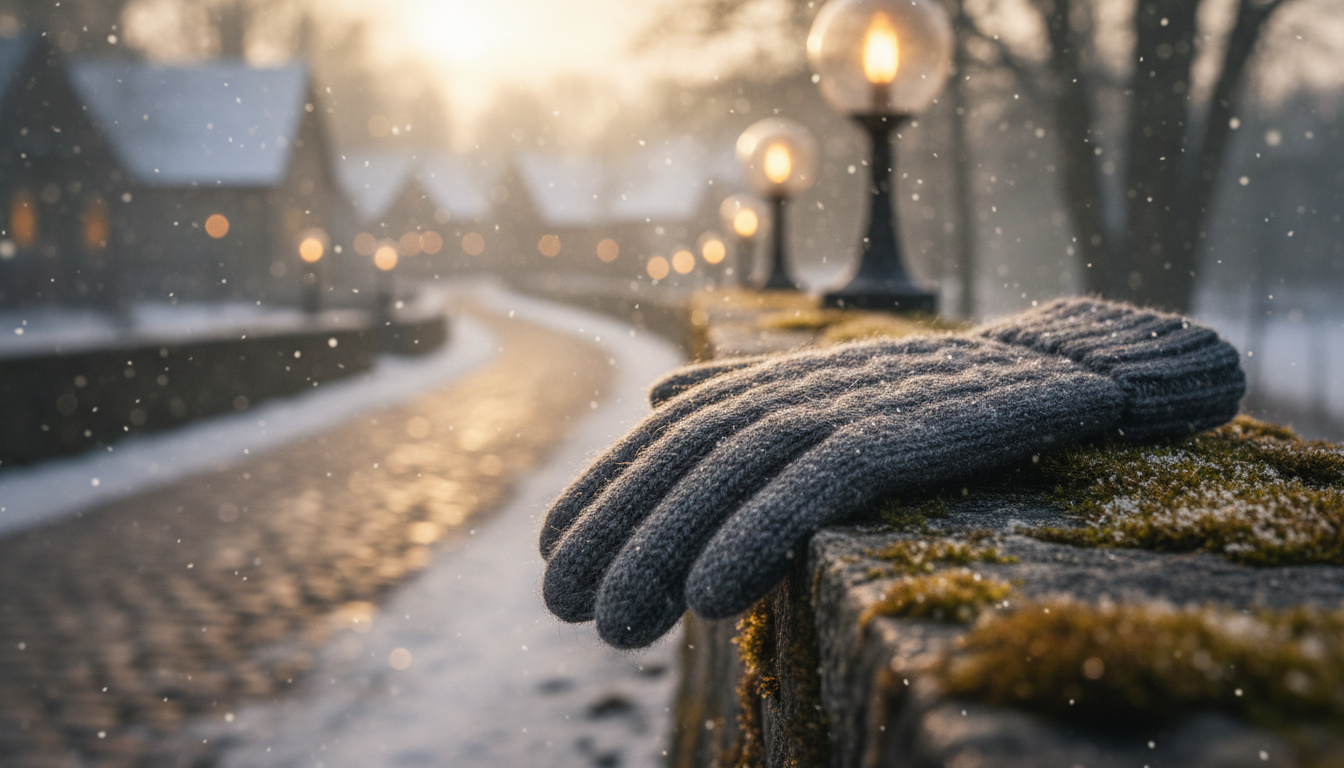
The winter in Brindlewood was not a season; it was an entity. It arrived with the smell of woodsmoke and old pine, settling into the valley like a heavy, patchwork quilt. It was a town of cobblestones and gas lamps that flickered a little too knowingly in the twilight. But the most peculiar thing about Brindlewood wasn’t the way the fog hugged the church spire or the way the bakery always smelled of cinnamon rolls even at midnight. It was the gloves.
In Brindlewood, nothing dropped was ever truly lost. Specifically, gloves.
If you were to drop a leather driving glove while fumbling for your keys near the apothecary, you wouldn’t panic. You wouldn’t retrace your steps with that frantic, sinking feeling in your gut. You would simply go home, make a pot of tea, and wait. Because in Brindlewood, the town had a way of returning things. It was a quiet magic, undramatic and reliable, like the tides.
Elias Thorne was new to Brindlewood. He had moved there three months after the funeral, seeking a place where the silence didn’t feel quite so loud. He was a man composed of sharp angles and gray wool, carrying a grief that felt far too heavy for his slender frame. He didn’t believe in magic, and he certainly didn’t believe in the inherent benevolence of lost accessories.
It happened on a Tuesday, the sort of blustery day that makes your eyes water. Elias was walking by the river, watching the dark water churn against the ice, when he pulled his hand from his pocket to adjust his scarf. The glove—hand-knitted, a deep charcoal with a subtle red thread woven through the cuff—slipped. It fell silently into the brush, unnoticed by Elias until he was halfway up the hill toward his cottage.
When he realized his left hand was bare, the cold didn’t hit his skin; it hit his heart. These weren’t just gloves. They were the last thing Clara had made for him. Her hands, already trembling with the illness that would take her, had moved the needles with a stubborn, rhythmic grace. “To keep you warm,” she had whispered, “when I can’t hold your hand anymore.”
Panic, sharp and bright, seized him. Elias ran back down the hill, his breath pluming in the freezing air. He scoured the riverbank. He parted the frozen reeds. He retraced his steps until the sun dipped below the horizon and the gas lamps sputtered to life. Nothing. The charcoal wool was gone, swallowed by the winter.
He didn’t sleep that night. He sat in his armchair, the remaining right glove clutched in his hand, feeling an emptiness that went beyond the physical object. Losing the glove felt like losing her all over again, a second severance of the tie that bound them.
The next morning, he went to the town square. He intended to put up flyers, though he felt foolish doing so. He found Mrs. Gable sweeping the snow in front of the post office. She was a round, cheerful woman who wore three sweaters at once.
“Lost something, dear?” she asked, leaning on her broom.
“A glove,” Elias said, his voice brittle. “It’s… it’s very important. It’s gray, wool.”
Mrs. Gable didn’t look concerned. Instead, she smiled, a soft expression that crinkled the corners of her eyes. “Oh, don’t you worry, Mr. Thorne. Brindlewood doesn’t keep what doesn’t belong to it. It’ll come back.”
“You don’t understand,” Elias snapped, more harshly than he intended. “It’s lost. I dropped it near the river. The current probably took it.”
“The river knows better than that,” she said simply. “Just keep your eyes open. The town has a funny way of delivery.”
Elias walked away, frustrated. He found the town’s superstition grating. It felt like false hope, a cruelty disguised as whimsy. He spent the next three days in a haze of misery, walking the streets with his head down, scanning the gutters, the snowbanks, the iron fences.
He saw other things, certainly. He saw a child’s red mitten perched perfectly on top of a fire hydrant, waiting to be claimed. He saw a workman’s heavy leather glove tucked neatly into the branches of a hawthorn bush at eye level. He saw the town doing its work for everyone else. But not for him.
By the fourth day, the snow began to fall in earnest. huge, fluffy flakes that dampened sound and turned the world into a soft, white room. Elias decided to give up. He placed the remaining right glove in a drawer in the hallway table, closing it with a finality that felt like a tomb door shutting.
He decided to go for a walk, not to search, but to forget. He walked without destination, letting his feet carry him where they wanted. He wound through the narrow alleys, past the library with its golden windows, past the park where children were building snowmen that looked surprisingly like the town mayor.
He found himself at the edge of town, near the old stone wall that bordered the orchard. It was a place he hadn’t visited before. The apple trees were bare, their gnarled black branches reaching up against the gray sky like ink strokes on parchment. It was beautiful in a melancholy way, a place that resonated with his internal landscape.
He sat on a wooden bench, brushing the snow off the slats. He closed his eyes, listening to the wind rattle the dry leaves that clung to the oaks nearby. He thought of Clara. Not the end, but the middle. The way she laughed when she burned toast. The way she hummed when she knitted.
“I miss you,” he whispered into the cold air. It was the first time he had said it aloud since moving to Brindlewood.
A crow cawed overhead, breaking the spell. Elias opened his eyes and looked to his left. There, sitting on the stone wall not three feet away, was a cat. It was a scruffy, orange thing with one torn ear, watching him with unblinking green eyes.
And underneath the cat’s front paws, serving as a warm mat against the cold stone, was the glove.
Elias stopped breathing. He didn’t move, afraid that if he shifted, the hallucination would shatter. The charcoal wool. The red thread in the cuff. It was unmistakable.
The cat meowed, a scratchy sound, and stood up. It stretched, arching its back, and then hopped down from the wall, leaving the glove behind. It paused for a moment, looking back at Elias as if to say, “Well? Are you taking it or not?” before disappearing into the orchard.
Elias reached out, his hand trembling. He picked up the glove. It wasn’t wet. It wasn’t muddy. It was warm. Inexplicably, impossibly warm, as if it had been held in a pair of hands just moments before.
He brought it to his face, inhaling deeply. It smelled of the river, yes, but also faintly of woodsmoke and the lavender soap Clara used to keep in her knitting basket. The scent washed over him, unlocking the tightness in his chest that he hadn’t realized he was carrying.
He slipped the glove onto his left hand. It fit perfectly, hugging his fingers, the wool settling against his skin like a reassurance. The match was complete. The circuit was closed.
Elias sat on the bench for a long time as the snow fell around him, coating his shoulders in white. He wasn’t just holding a piece of clothing; he was holding a message. The town hadn’t just returned a lost item. It had returned a piece of his history, proving that things—and people—leave marks that aren’t easily washed away by time or currents.
When he finally walked back into town, Brindlewood seemed different. The gas lamps glowed a little warmer. The cobblestones seemed less uneven. He passed Mrs. Gable at the post office again. She didn’t ask if he had found it. She just nodded, a small, knowing smile playing on her lips.
Elias nodded back, raising his left hand in a small wave. The charcoal wool caught the light.
He walked home, the rhythm of his steps lighter than it had been in months. He realized then that the magic of Brindlewood wasn’t about the objects themselves. It was about the reminder that nothing is truly gone as long as there is a place, or a person, to remember it home. The glove had found its way back, and in doing so, it had helped Elias find his way back, too.