
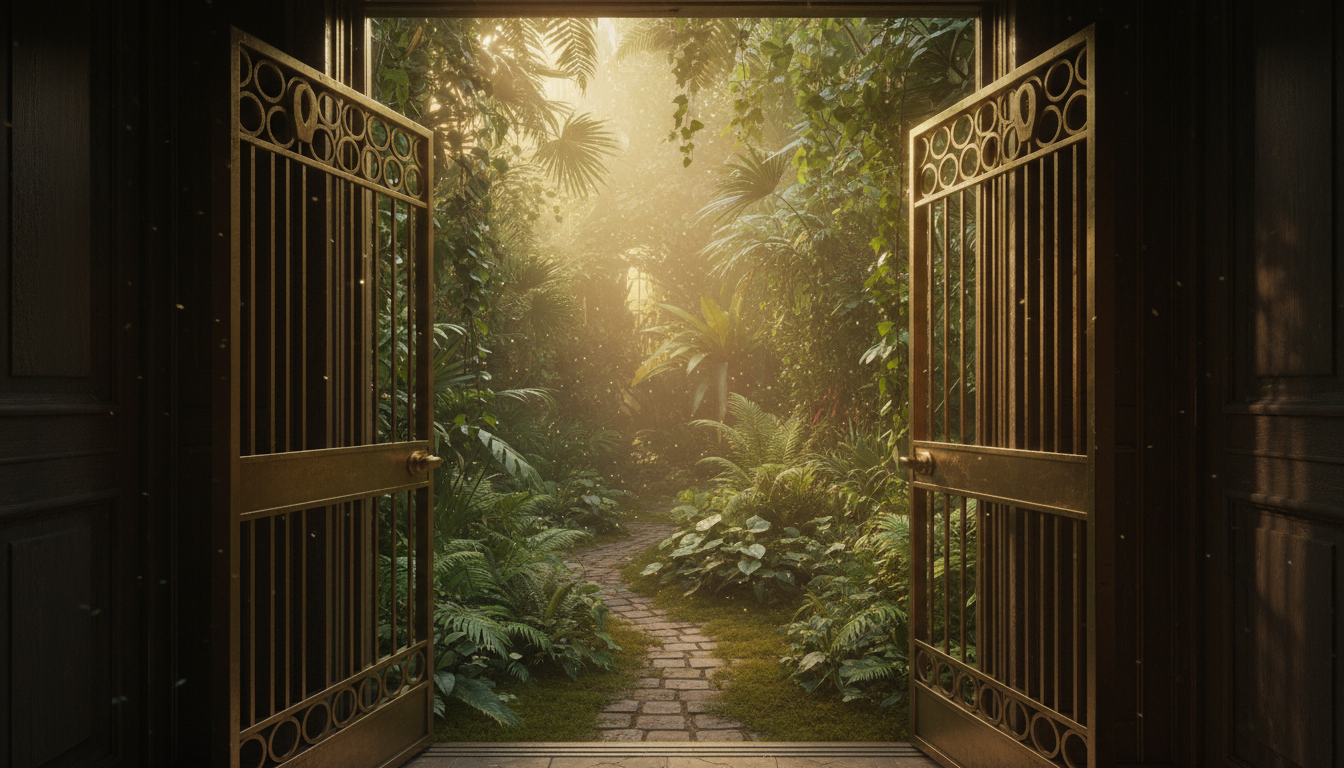
The brass grille of the elevator in the Hawthorn Building did not just close; it interlaced like the fingers of two hands clasping in prayer. It was an old machine, a relic of a time when buildings were constructed with the intention of outlasting the people who built them. The floor inside was parquet, worn smooth by decades of nervous shuffling, and the air always smelled faintly of lemon oil and ozone. People in the city knew about the Hawthorn, though it wasn’t listed in any tourist guidebooks or architectural digests. They knew it because, at some point in their lives, they had found themselves standing in its lobby, watching the dial above the doors swing like a pendulum.
Elias Thorne entered the lobby at nine in the morning, clutching a leather portfolio that felt too heavy for its contents. He was there for an interview on the fourteenth floor, a corner office belonging to a prestigious firm that managed wealth for people who had too much of it. Elias did not have too much of anything, except perhaps anxiety. He pressed the button for the fourteenth floor with a thumb that trembled slightly, then leaned back against the mahogany rail, closing his eyes to rehearse his opening statement.
The elevator hummed to life. It was a deep, resonant sound, more like a cello bowing a low C than a mechanical motor. The ascent began smoothly, a gentle lift that felt less like machinery and more like buoyancy. Elias watched the floor indicator lights flicker past: two, three, four. He checked his watch. He had ten minutes.
The car slowed. The sensation was distinct, a gradual deceleration that felt intentional. Elias frowned. He hadn’t felt the car stop for anyone else, and he was the only passenger. The light for the sixth floor illuminated with a soft amber glow. The brass gate retracted, and the heavy outer doors slid open.
There was no hallway. Instead, the elevator opened directly into a room filled with morning light and the overwhelming scent of sawdust and drying varnish. It was a luthier’s workshop. Violins and cellos hung from the ceiling like curing hams, their wood gleaming in rich gradients of auburn and honey. An old man with spectacles thick as bottle bottoms sat at a workbench, carefully shaving a curl of wood from a bridge.
Elias reached for the close button. This was a mistake. He had no time for mistakes. But his hand hovered. The sound in the room was absolute silence, save for the rhythmic scrape of the tool against maple. It was a peace so profound it felt physical, like a cool hand on a fevered forehead. The anxiety that had been tightening a knot behind Elias’s ribs loosened, just a fraction. He stood there for a full minute, watching the dust motes dance in the sunbeams, breathing in the scent of raw creation. The old man never looked up, yet he nodded, as if acknowledging a guest who had come merely to breathe.
The doors slid shut. The elevator resumed its climb. Elias exhaled, realizing he had been holding his breath since the street.
He looked at the panel. The light for fourteen was still lit. He checked his watch again. Five minutes. He tapped his foot. The elevator continued upward, then slowed again. Not fourteen. The ninth floor.
Elias sighed, a sound of frustration that died in his throat as the doors opened. This time, the air was humid and smelled of rich, damp earth. He was looking into an indoor conservatory, a jungle of ferns and monsteras climbing toward a glass skylight that shouldn’t have been possible on the ninth floor. The sound of trickling water filled the small elevator car. A young woman was kneeling in the dirt, repotting a massive peace lily. She looked up, wiping a streak of soil from her cheek, and offered a tired but genuine smile. She didn’t ask him what he wanted. She simply held his gaze, her eyes crinkling at the corners, radiating a simple, unassuming kindness.
Elias found himself smiling back. It was an involuntary reflex, a muscle memory he had forgotten he possessed during the grueling months of job hunting. The connection lasted only a few seconds, but in that brief exchange, the crushing weight of his impending interview—the need to impress, to perform, to be perfect—seemed to evaporate. He was just a man in a box, and she was a woman with a plant. The stakes were not life and death. They were just life.
The doors closed. The hum returned. Elias leaned his head back against the wall. He was going to be late. The realization should have panicked him, but the panic was gone, replaced by a strange, fluid acceptance. The elevator was not broken. He understood that now. The Hawthorn didn’t malfunction; it intervened.
It passed the fourteenth floor. Elias watched the number light up and fade without stopping. He didn’t press the button again. He stood still, waiting to see where he was actually going.
The lift climbed higher, past the offices, past the storage rooms, past the known geography of the building. It finally came to a rest at the very top, the twentieth floor, where the button was simply marked ‘R’.
The doors opened to the roof. The wind buffeted Elias’s suit jacket, carrying the salt of the distant harbor and the noise of the city below, muted by height. He stepped out. The surface was graveled, dotted with vents and chimney pots, but near the edge stood a simple wooden bench facing the skyline.
He walked to the edge. The city sprawled out like a circuit board, chaotic and electric. From up here, the office building where he was supposed to be sitting in a velvet chair begging for a salary looked small. The people on the sidewalks were invisible. The urgency of the morning dissolved into the vast blue dome of the sky.
Elias sat on the bench. He took the leather portfolio, the resume printed on thick cream paper, and set it on the gravel beside him. He realized he didn’t want the job. He didn’t want the fourteen-hour days, the fluorescent lights, the golden handcuffs. He wanted the scent of sawdust. He wanted the humidity of the greenhouse. He wanted the feeling of the wind on a Tuesday morning.
He sat there for an hour, watching the clouds drift, reconstructing his life in his mind not as a ladder to be climbed, but as a garden to be tended. The fear of the future was replaced by a quiet curiosity. He would find something else. Something that felt like the warmth of the wood shop or the honesty of the soil.
When he finally stood up and walked back to the elevator, the brass gates opened immediately, as if they had been waiting for him to finish his thought. He stepped inside. He didn’t press a button. He didn’t need to.
The elevator began its descent, humming its low, mournful cello note. It carried him down, past the missed opportunities and the wrong turns, delivering him back to the lobby, not as the man who entered, but as the man he was supposed to be. The doors opened to the street, and Elias walked out into the sunlight, leaving the heavy portfolio behind on the parquet floor.