
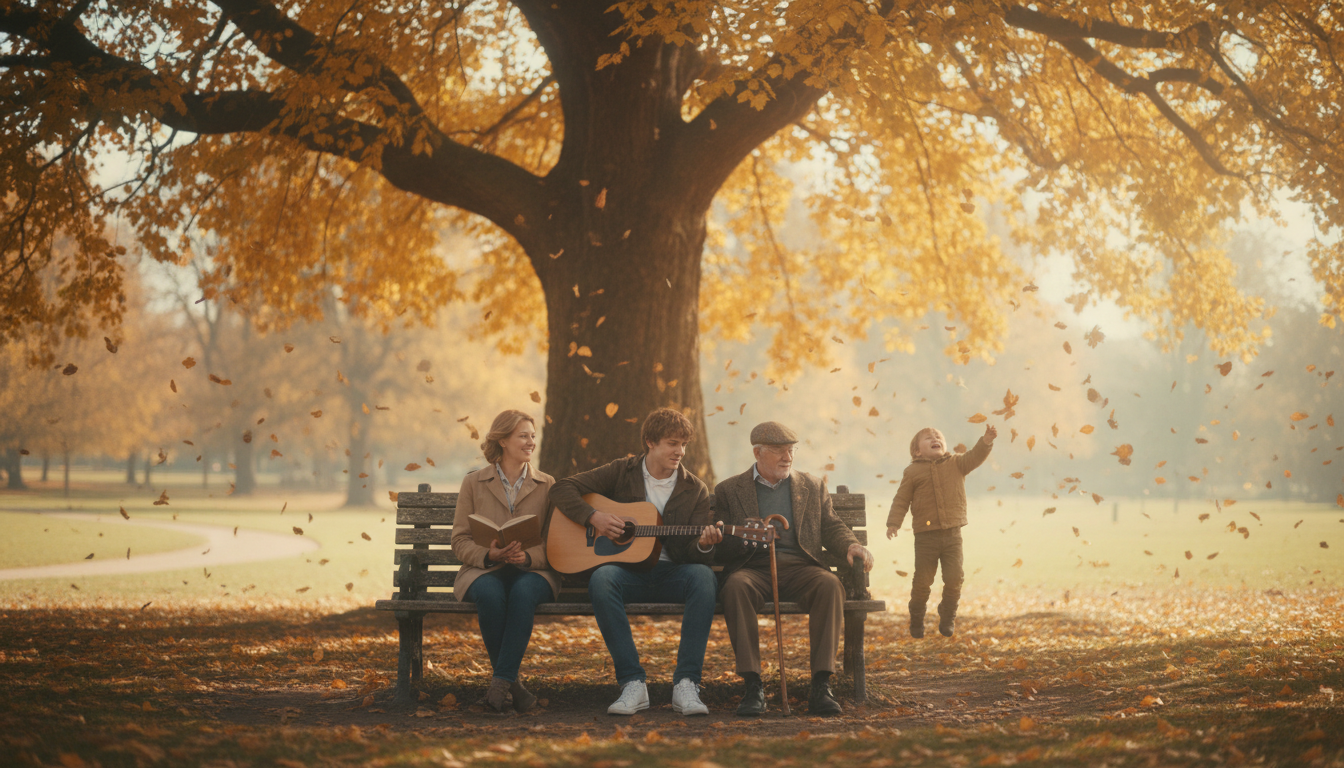
In the quietest corner of Oakhaven Park, beneath the sprawling canopy of an ancient sycamore that had seen more seasons than the city surrounding it had seen paved roads, sat a bench. To the casual observer, it was entirely unremarkable. It was constructed of seasoned oak, silvered by years of rain and sun, supported by wrought-iron legs that curled into the soil like roots. It looked, by all standard metrics, like a bench designed to seat three people comfortably, or four if they were particularly fond of one another.
Elias Thorne was a man of standard metrics. As a retired structural engineer, he viewed the world through a lens of load-bearing capacities, tensile strength, and finite dimensions. He found comfort in the immutable laws of physics. Things fit, or they did not. Spaces were occupied, or they were empty. There was no middle ground in geometry.
Elias visited Oakhaven Park every Tuesday and Thursday at exactly two in the afternoon. He would sit on a green metal chair near the duck pond—never the wooden bench—and eat a sandwich wrapped in wax paper. It was from this vantage point, over the course of six months, that the impossible nature of the oak bench began to unravel his understanding of reality.
The first time he noticed it, the autumn leaves were just beginning to turn the color of burnt sugar. Elias watched as two young mothers with bulky strollers sat on the bench. They took up the majority of the space. A moment later, an elderly gentleman with a cane approached. Elias expected him to pass by, seeing the lack of room. Instead, the man nodded, the women smiled, and he sat down. Elias squinted. It seemed tight, but manageable. Physics was merely being stretched, not broken.
But then, a teenager with a guitar case arrived. The case was large, cumbersome. Surely, there was no space left. Yet, with a fluid motion that defied the visual evidence, the teenager sat. The bench did not appear to lengthen. The occupants did not appear to be crushed against one another. They simply… fit. The bench held them all, comfortably, with a polite amount of space between each shoulder.
Elias had stopped chewing his sandwich. He stared, trying to calculate the width of the slats versus the hip width of the average human. It didn’t add up. By the time a jogger stopped to tie his shoe and found a spot on the far end without disturbing the guitar case, Elias felt a distinct prickle of unease at the back of his neck.
Over the coming weeks, the phenomenon repeated itself with maddening consistency. Elias brought a notebook. He recorded the weather, the time of day, and the headcount. One rainy Tuesday, he counted seven people on the bench: a couple sharing an umbrella, a nurse in scrubs, a man reading a broadsheet newspaper, two school children trading cards, and a woman holding a basket of apples. Seven people on a bench built for three. And yet, looking at it, it never appeared crowded. It looked cozy. It looked like a hearth fire in the middle of a cold world.
The bench became an obsession. Elias lay awake at night, visualizing the grain of the wood. Was it warping space? was it a collective hallucination? Or was it something softer, something that couldn’t be measured with a slide rule?
Winter arrived, stripping the sycamore bare and coating the park in a hush of frost. Elias’s walks became harder. His arthritis was flaring, and the loneliness of his empty apartment felt heavier than usual. His wife, Martha, had been gone for five years, but the silence she left behind seemed to grow louder, not quieter, with time. He felt like a structure whose foundation was slowly eroding.
On a particularly biting December afternoon, Elias found himself walking through the park without his sandwich. He felt frail. The cold wind cut through his coat, settling deep in his bones. He needed to sit, but the metal chairs by the pond were covered in ice and looked unforgivingly cold.
He looked toward the oak bench. It was occupied, of course. A family was there—parents and two children—huddled together with hot chocolates. A large golden retriever sat between them. To anyone else, the bench was full. To Elias, the man of logic, the bench was at maximum capacity and then some.
He turned to leave, resigning himself to the long, painful walk back to the bus stop. His knee buckled slightly, a sharp jolt of pain that made him gasp.
“Sir?” a voice called out.
Elias looked up. The father on the bench was waving him over. ” plenty of room, come take a load off.”
Elias hesitated. “Oh, I couldn’t. You’re all… settled.”
“Nonsense,” the mother said, her voice bright and warm, like a bell in the winter air. “There’s always room for one more.”
Elias stepped closer, his engineer’s brain screaming that this was impossible. He watched the wood. He watched the iron legs. He watched the people. They didn’t scoot over. They didn’t shrink. The space simply was. Between the father and the golden retriever, a space opened up—a space that looked welcoming, wide enough for a tired man with an aching heart.
Slowly, suspiciously, Elias lowered himself onto the wood. It was warm. It shouldn’t have been—it was freezing out—but the wood held a gentle, radiating heat, as if it had stored the summer sun just for this moment. He fit perfectly. He didn’t feel the dog’s fur against his leg, nor the man’s coat against his shoulder. He felt held.
“Cold one today,” the father said, passing a spare paper cup of cocoa to Elias. “My wife always brings an extra. Just in case.”
Elias took the cup, his trembling hands stilled by the warmth. “Thank you,” he whispered. He looked down the line of the bench. It stretched away from him, seemingly infinite in its capacity to hold humanity, yet intimate enough to feel like a kitchen table.
He realized then, as the steam from the cocoa rose to tickle his nose, that he had been measuring the wrong things. He had been measuring inches and pounds, wood and iron. But the bench didn’t operate on the laws of physics. It operated on the laws of need. It expanded not in length, but in compassion. It was a physical manifestation of the idea that no one should have to stand alone in the cold.
Elias sat there for an hour. The family eventually left, replaced by a pair of lovers, then a group of friends laughing over a joke. Elias remained, the constant in the equation. He wasn’t taking up space; he was sharing it. For the first time in five years, the silence in his mind was replaced by the low hum of connection.
When he finally stood up to leave, the pain in his knee had dulled to a manageable throb. He looked back at the bench. It was empty now, reverting to its modest, three-person appearance. Just wood and iron under a tree.
Elias smiled, a genuine, crinkle-eyed smile that softened his rigid face. He didn’t need to measure it anymore. He understood the math now. The bench was exactly as big as it needed to be, and not an inch smaller. And tomorrow, he decided, he would bring a thermos of extra coffee. Just in case.