
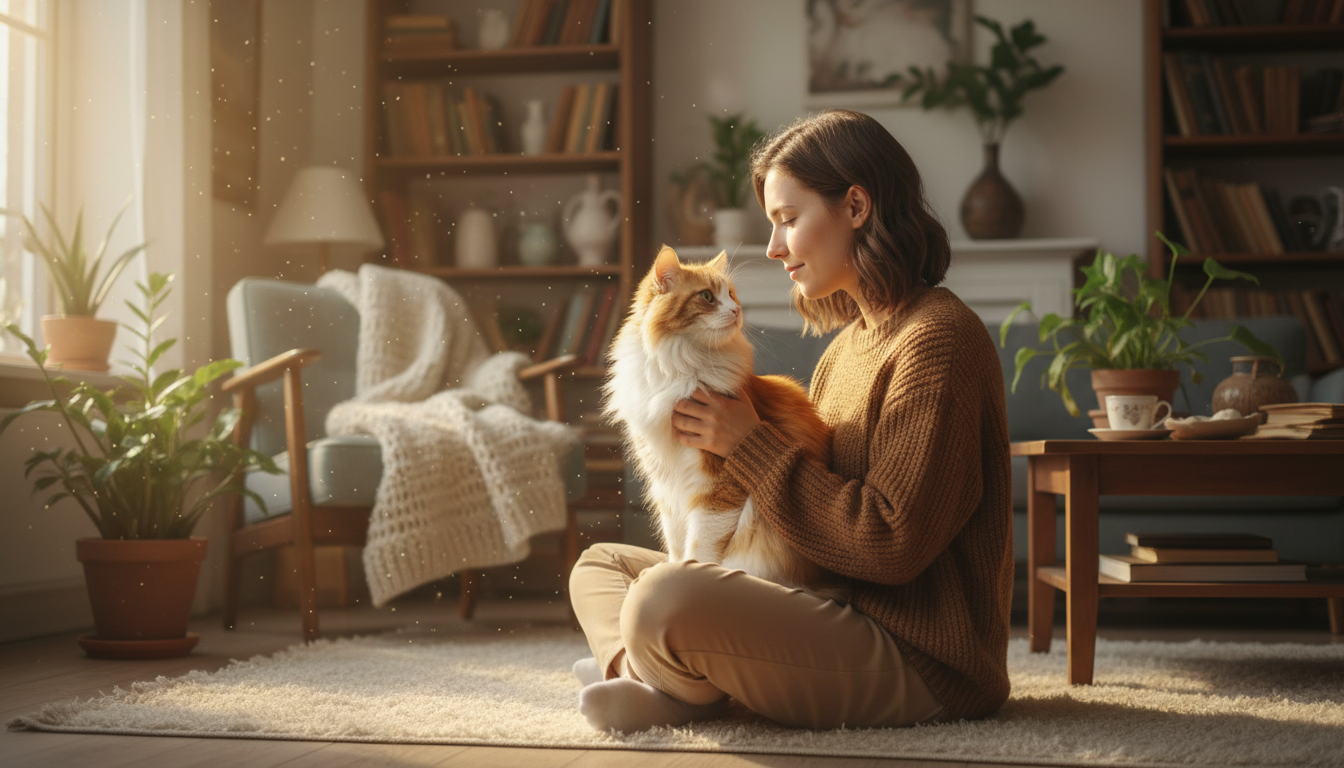
There are certain silences in a house that feel heavier than others. For Elara, the silence of her cottage on the edge of the sprawling, mist-covered woods was not empty, but expectant. It was the kind of quiet that asked questions, waiting for an answer that she didn’t quite have the language to speak. She lived a life of gentle routine—tea at sunrise, illustration work by the north-facing window, and walks that meandered through the village but rarely intersected with the lives of others.
She had been thinking about a companion for months. The thought wasn’t a lightning bolt of decision but a slow-growing moss, covering the stones of her hesitation. She imagined a dog, perhaps, or a bird that would sing back to the radio. But the universe, it seemed, had already drafted a different blueprint.
It began with the feeling of being watched, not with malice, but with a steady, curious intensity. It happened first while she was weeding the lavender beds. The sensation prickled the back of her neck. When she turned, she saw nothing but the swaying tall grass and the dappled sunlight filtering through the oaks. Yet, the air felt displaced, as if something significant had just occupied the space and vanished.
Two days later, she found a gift on her back porch. It was not the usual grim offering of a hunter—no feathers or bones. It was a single, perfect magnolia leaf, green and glossy, placed precisely in the center of her doormat. There were no magnolia trees in her yard; the nearest one grew three streets over, behind the old bakery. Elara picked it up, twirling the stem between her fingers. It felt like a calling card.
The invisible guest became a shadow in her periphery. She would see a flicker of russet fur near the woodpile, or catch the reflection of amber eyes in the darkening window pane as she washed dishes. Whenever she went to the door to look, the yard was empty, save for the wind chimes singing their lonely song. It didn’t feel like a haunting; it felt like an interview. She was being vetted.
One rainy Tuesday, the feeling of incompleteness became too loud to ignore. Elara put on her raincoat and drove to the county shelter, a modest brick building that smelled of bleach and wet fur. She told herself she was just looking. She told herself she wanted a kitten, something small and moldable, a blank slate.
The shelter was a cacophony of barking and mewing, a symphony of need. Elara walked past the rows of cages, her heart aching with the impossibility of saving them all. She stopped at the kitten enclosure, watching a tumble of black and white fluff balls wrestle over a toy mouse. They were adorable, chaotic, and undeniable. She reached out to touch the glass, smiling as a tiny paw batted at her finger.
But then, she felt it again. The weight of a gaze. The prickle on her neck.
She turned slowly. Across the aisle, in a cage designated for older, harder-to-adopt cats, sat a large, ginger tabby. He wasn’t pacing. He wasn’t meowing or rubbing against the bars. He was sitting perfectly still, his tail wrapped neatly around his paws like a statuette carved from autumn leaves.
His eyes were the color of old honey, and they were locked onto hers with unnerving recognition. He didn’t look like an animal hoping to be chosen; he looked like a traveler who had finally arrived at his destination.
Elara stepped away from the kittens and approached his cage. The card on the front read: Barnaby. Approx. 5 years old. Found wandering. Aloof.
“I wouldn’t bother with that one, miss,” a volunteer said, sweeping past with a broom. “He’s a bit of a ghost. Doesn’t care for people much. We’ve had him for three weeks and he hasn’t purred once. He just… watches.”
Elara ignored the warning. She knelt, bringing her face level with the wire mesh. “Hello,” she whispered.
Barnaby didn’t blink. He simply lifted his chin. Then, with deliberate slowness, he reached one paw through the bars. He didn’t claw or scratch. He extended his leg as far as it would go and rested his paw gently on the sleeve of her raincoat. He held it there, anchoring her to the spot.
The air shifted. The noise of the shelter seemed to dial down, fading into a dull hum. In the silence between them, Elara saw the flash of russet fur by her woodpile. She remembered the magnolia leaf on the doormat. The connection wasn’t forged in that moment; it was acknowledged. He hadn’t been lost. He had been waiting for the logistics to catch up with the decision he had already made.
“Can I meet him?” Elara asked, her voice trembling slightly.
The volunteer looked surprised but unlocked the cage. “Watch your hands,” she warned.
Barnaby didn’t bolt for the door. He stepped out with dignity, bypassed the floor, and climbed directly into Elara’s lap. He circled once, settled his weight against her chest, and let out a sound that defied the volunteer’s description—a deep, resonant purr that vibrated through Elara’s ribs, matching the rhythm of her own heart. He buried his face in the crook of her neck and let out a long, shuddering sigh.
He smelled of sawdust and rain. He smelled like her garden.
“I think,” Elara said, tears unexpected and hot in her eyes, “that he’s already mine.”
The paperwork was a formality. The drive home was quiet, but the expectant silence of the car had changed. It was no longer a question; it was an answer. When they arrived at the cottage, Elara opened the carrier. She expected him to explore, to sniff the corners, to exhibit the caution of a creature in a new environment.
Barnaby stepped out. He didn’t sniff the perimeter. He didn’t hide under the sofa. He walked with confident familiarity straight to the north-facing window, hopped onto the sill where the afternoon light hit the hardest, and began to groom a paw. He looked at Elara, then at the magnolia tree visible in the distance through the glass, and gave a slow blink.
That night, the house felt different. The shadows weren’t empty spaces anymore; they were guarded. Elara sat reading in her armchair, the lamp casting a warm glow over the room. Barnaby lay on the rug, not sleeping, but watching the door with a protective vigilance.
It wasn’t until a week later that Elara found the proof she hadn’t needed but cherished anyway. She was cleaning behind the heavy oak dresser near the back door, a place she hadn’t moved in years. Tucked far back in the corner, accessible only through a small gap in the floorboards that led to the crawlspace, was a small pile of treasures.
A blue jay feather. A smooth river stone. And a dried, crumbling magnolia leaf.
He hadn’t just been watching her from the garden. He had been living in the bones of her house, perhaps for weeks, leaving gifts she couldn’t see, waiting for her to be ready to invite him into the light. He hadn’t been adopted that day at the shelter. He had simply allowed himself to be found.
Elara looked at the cat, dozing now on the sofa, his belly exposed in total trust. He wasn’t a pet she had selected from a lineup. He was a roommate who had finally decided to sign the lease. He had chosen her solitude as the perfect place to rest his own, and in doing so, he had turned a quiet house into a home.