
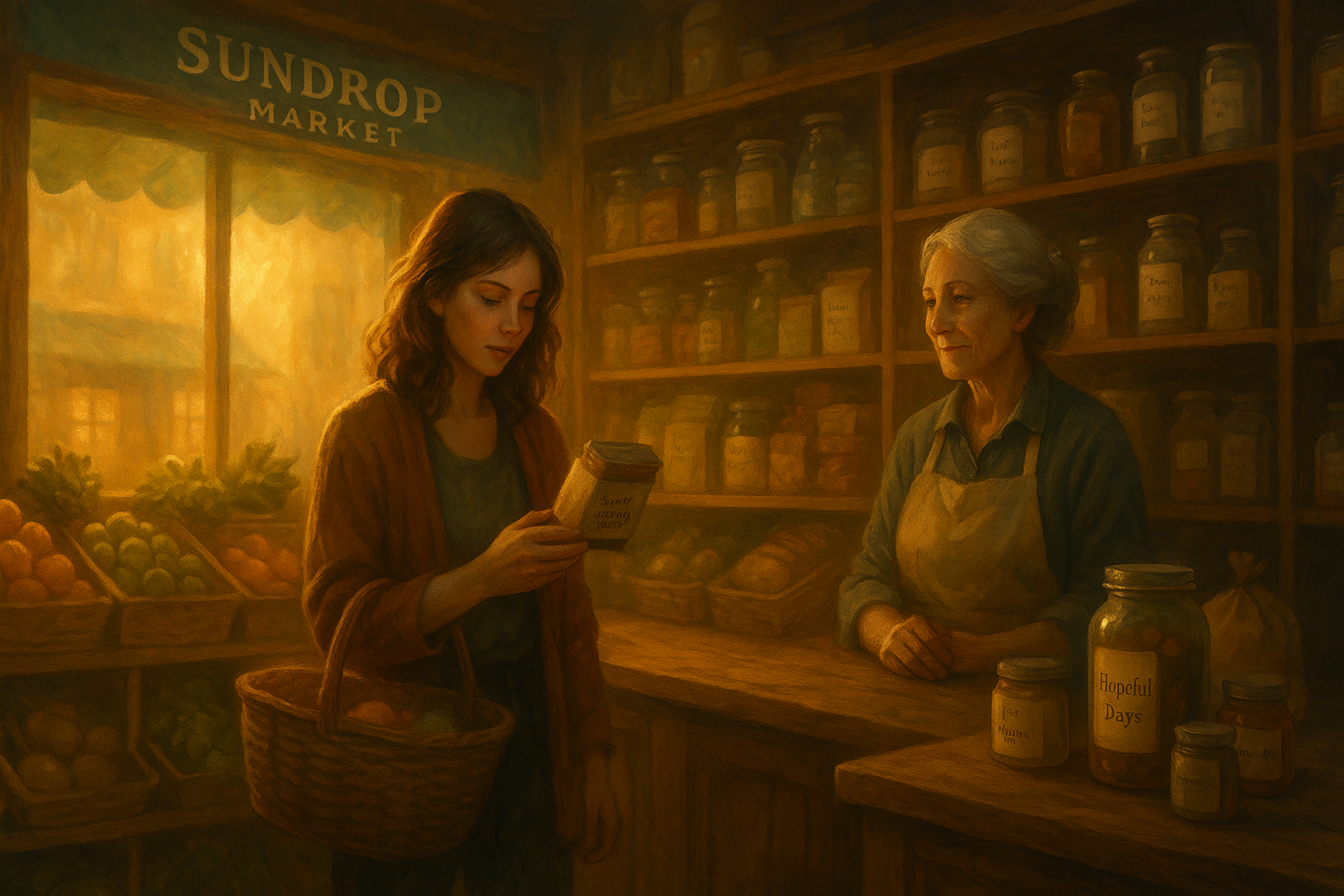
The grocery store was not supposed to be there.
That’s the first thing Marisol noticed.
She had lived on the corner of Juniper and 8th for four years. She knew every broken tile of that street. Every shop that came and went. The dry cleaner that closed. The pet store that opened and then mysteriously vanished after five months. The taquería that somehow survived everything.
But she had never, in four years, seen a shop between the empty laundromat and the flower stall.
Yet here it was now.
A narrow storefront with a soft green awning and windows fogged with gentle golden light, like evening sun had decided to live inside.
Painted on the glass in looping white letters:
SUNDROP MARKET
Fresh Goods for the Life You’re Building
Marisol slowed her steps.
“That’s new,” she murmured… even though somehow it didn’t feel new.
It felt… overdue.
She hadn’t planned on shopping.
Her fridge was half empty, her freezer entirely so. She’d spent so long living on takeout containers and leftovers that the idea of actually buying groceries felt almost optimistic.
Optimism, lately, had felt dangerous.
Because optimism had been a thing she used to have.
Before the job loss.
Before her brother moved out of state.
Before her relationship ended quietly instead of dramatically, leaving a strange empty space instead of a wound.
Now life felt more like survival than living.
But something about that little store tugged at her.
Not urgently. Not forcefully.
Just… gently.
Like a hand resting at the small of her back.
So she pushed the door open.
A bell chimed — low and musical.
Inside, the air smelled like citrus and herbs and fresh bread.
The shelves were wooden, warm-toned, not the fluorescent metal aisles of big stores. Baskets overflowed with fruit that looked like it had been painted by someone who believed color was sacred. Jars of honey glowed like captured sunlight. Rows of spices shimmered slightly, as though each one held a secret.
But something was strange.
There were no brand names.
No prices.
Just small tags in handwritten ink:
“Courage, sliced thin”
“For long afternoons”
“Helps with grief”
“Use sparingly”
“Best when shared”
Marisol froze.
“What kind of place is this?” she whispered.
“Just a grocery store,” said a voice behind her.
She turned.
A woman stood near the counter, wiping her hands on a linen towel.
She had silver threaded through her hair and laugh lines resting comfortably around her life. Not the look of someone who had avoided sadness, but of someone who had outgrown being afraid of it.
“For,” the woman added, “the parts of life people forget to feed.”
Marisol swallowed.
“Do I know you?”
The woman smiled like she’d been waiting all day for that question.
“No,” she said. “But I know why you’re here.”
Marisol looked around again at the bizarre labels, the glowing jars.
“I think I took a wrong turn,” she said weakly.
“You took the right one,” the woman replied.
She stepped closer, her voice kind and steady.
“My name is Alma. And this place only shows up when someone needs it.”
The words should have made Marisol laugh.
But instead, her throat tightened.
“Needs what?” she asked quietly.
Alma gestured around.
“What they’ve been missing,” she said.
Marisol’s eyes drifted back to the shelves.
To a basket of oranges labeled:
For lost beginnings
To a loaf of bread marked:
Good for second chances
To a tiny jar of something glowing pale blue:
For nights when you feel invisible
Her chest fluttered uncomfortably.
“I don’t have much money,” she said, automatically. A reflex at this point.
Alma chuckled.
“We don’t take money.”
Marisol blinked.
“What do you take?”
Alma smiled, soft and knowing.
“Honesty.”
They walked the aisles together.
Alma didn’t push anything on her. Didn’t hover. Just walked beside her, like a kind quiet guide.
Marisol ran her fingers along the shelf.
Her hand hovered over a bundle of herbs tied with twine.
The tag read:
For letting go of the past gently
Her pulse jumped.
“How do you know what people need?” she asked.
Alma answered without hesitation.
“You tell me,” she said. “Even when you don’t use words.”
Marisol swallowed hard.
“I don’t think I know what I need,” she admitted.
Alma smiled gently.
“That’s all right,” she said. “Start with what calls you.”
So Marisol did.
She picked up strange things.
A carton of milk labeled: For forgiveness
A small paper bag of seeds: Plant when you feel brave
A bar of dark chocolate: For when you almost give up
A bundle of rosemary: For remembering who you are
Each item felt warm in her hands.
Alive in some quiet way.
She didn’t understand it.
But some part of her didn’t want to.
She just wanted to hold them.
At the counter, Alma began placing each item carefully into a simple brown bag.
“How much?” Marisol asked again, although she already knew the answer would be strange.
Alma looked at her.
“Tell me,” she said softly, “what’s weighing heaviest on you?”
The question landed gently.
But it landed.
Marisol opened her mouth to deflect.
To joke.
To lie.
Instead, what came out surprised her.
“I feel like…,” she stopped, breath shaking, “…like my life stopped making sense and no one told me what to cook instead.”
Alma’s eyes softened.
“Then this,” she said, tying the bag, “will be enough.”
Outside, the city felt the same.
Cars. Noise. Wind between buildings.
But Marisol walked slower now.
When she got home, she unpacked the bag on her kitchen table like sacred artifacts.
The bread warmed.
The seeds pulsed faintly.
The jar of blue light hummed.
She didn’t even know how to use most of it.
Except…
The chocolate.
Later, when the loneliness came in like it always did after 9PM, she’d unwrapped it.
The label had said:
For when you almost give up
She broke off a piece.
And when it melted on her tongue, something strange happened.
She remembered a version of herself from years ago.
Standing barefoot in her childhood kitchen, dancing while her mother cooked. Laughing too loudly. Dreaming ridiculous dreams about traveling, about writing, about building something beautiful from nothing.
She remembered her courage.
Not as a concept.
As a feeling.
Tears slid down her cheeks.
Not sad ones.
Grateful ones.
The next morning, she planted the seeds in a little pot by her window.
She watered them with the milk for forgiveness.
She added rosemary to her eggs.
She tore the bread for a neighbor downstairs she hardly spoke to.
And every action felt… meaningful.
Like she was assembling a recipe she’d forgotten existed.
Not for dinner.
But for herself.
She went back the next day.
The storefront was gone.
Between the laundromat and flower stall stood only a brick wall, worn and ordinary.
For a moment, doubt crept in.
A beautiful hallucination, maybe.
A stress-induced fantasy.
Desperation dressed as magic.
But then she felt warmth in her pocket.
She pulled out one of the items — a small jar labeled:
Come back when you need a reminder.
And she smiled.
Because somehow, she knew she would.
Not to buy groceries.
But to remember that her life was not wasted.
Not broken.
Not empty.
It was simply a kitchen mid-recipe.
And she had just been given the ingredients she’d forgotten she deserved.